
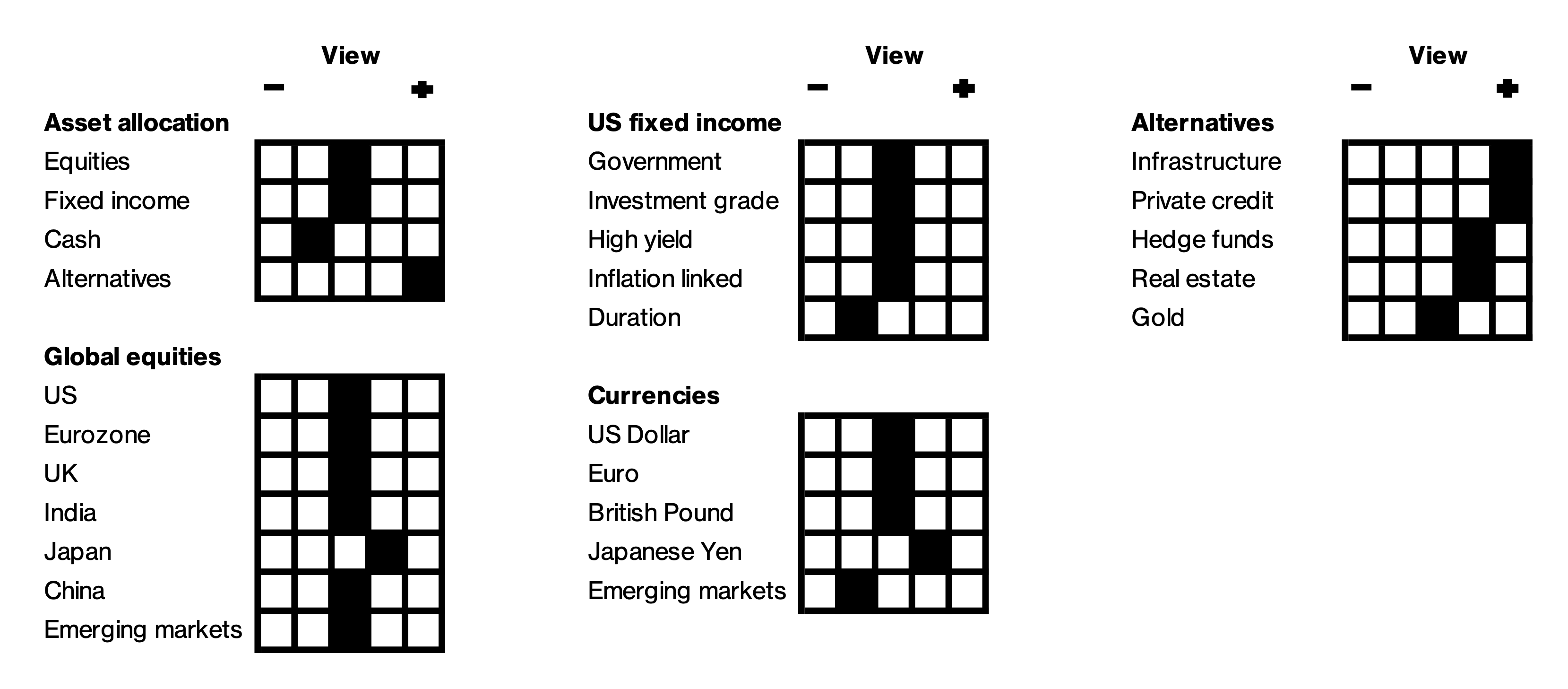
April 2025 reminded us that attempting to time the market is a fruitless endeavour. From the last week of March to the days following President Trump’s “Liberation Day” on 2 April, the S&P500 index fell by nearly 14% – a level where we felt markets were oversold. At the same time, the US dollar depreciated, and gold hit a record high. Since then, the S&P500 has staged a significant recovery. The adage on time in the market, not market timing was proven on 9 April, where we saw a surge of 9.52% – the S&P500’s largest one-day percentage gain since 2008 and the third biggest single-day increase since World War II. Whilst we can breathe a sigh of relief over the recovery, what is driving this level of volatility and what does it mean for the future?
What happened and what does it tell us?
The recovery in equities has been led by the so-called Magnificent Seven, with strong Q1 results from Apple, Amazon, Microsoft and Meta over the last two weeks. Whilst these results are encouraging, this masks underlying challenges for the US economy. Back in early April, with some theatre, President Trump announced far reaching tariffs on key trading partners. With the market turmoil that ensued, he delayed or diluted the most far-reaching of these tariffs. Whilst this supported the recovery in equities, it has left US investors, businesses and households with uncertainty. The resulting economic data has been a mixed picture. Measures of economic growth and activity have pointed to a slowdown, but actually not as much of a slowdown as might reasonably have been expected with, for example, last week’s ISM Purchasing Manager’s Index – an indicator of activity in the manufacturing sector – falling but coming in above economists’ consensus estimates, a reminder of the robustness of the US economy.
Is the US heading to recession and what would the implications be for equities?
But is the US heading into recession? The imposition of tariffs has certainly been a driver in elevating that risk, but it is far from a foregone conclusion. Looking across the outputs from global banks, it remains finely balanced – for example, with JP Morgan putting the risk of recession at 60%, Goldman Sachs at 45% but with UBS most optimistic. Similarly, Reuters’ poll of economists sees the risk at 45% and the International Monetary Fund at 40%. Whilst the ideological stance on tariffs espoused by President Trump on Liberation Day has not completely dissipated, our base case envisages more pragmatism in the bilateral discussions between the US and key trading partners. In line with the consensus views of economists, a US recession may well be avoided.
If a US recession did arrive, how should investors react? This might be surprising. Firstly, in the last 16 out of 31 US recessions, US equities performed positively during the recession. In general, irrespective of whether equities are positive by the end of a recession, recovery has begun during the recession, and post-recession there has then typically been a pattern of stronger market returns. For sensible investors holding a diversified multi-asset class portfolio, further protection from falls in equities has come through other less correlated asset classes.
Looking back over the last 150 years of US stock market history, it would have required an investor to correctly predict the direction of equities over 70% of the time – moving all their exposure into cash during negative periods – to beat the “buy and hold” return of approximately 9% p.a. This would be incredibly difficult for anyone to achieve. In light of this data and the likelihood of a US recession being 50:50, it is our view that investors with a diversified portfolio and a long-term time horizon should remain invested.
Over the last 150 years of US stock market history, it would have required an investor to correctly predict the direction of equities over 70% of the time – moving all their exposure into cash during negative periods – to beat the “buy and hold” return of approximately 9% p.a.
With respect to equities in general and US equities specifically, we maintain a balanced view. As it stands, the US continues to provide the best overall exposure to the seismic shifts that are occurring as a result of the development of artificial intelligence and will be well placed to benefit from productivity gains in the long-term. The level of spend on research and development, as well as the number of patent applications is unparalleled. The US continues to have more than half of the world’s “unicorn” companies – private ventures valued at $1bn or more.
Beyond US equities
Looking elsewhere, we have for several months advocated for opportunities in European equities which have provided useful diversification from the US. We see the possibility of further rate cuts from the European Central Bank supporting improving company earnings, as well as increased defence and infrastructure expenditure, the resolution of the Ukraine-Russia conflict and the potential for fiscal loosening – higher spending and/or lower taxation – from certain governments supporting overall economic growth. In certain sectors, attractive valuation gaps exist in comparison to the US, and we observe that capital flows into European equities are only just beginning.
We retain a positive stance on Japan equities where valuations remain attractive in an environment of corporate governance reform and share buy-backs, but we remain cognisant of risks around US tariffs and the implications of a strengthening Japanese yen.
We see India as attractive in the long term – equities will benefit from favourable relative economic and corporate earnings growth over coming years, as well as increasing domestic flows into equities. That said, short term volatility could remain owing to US tariff risks and geopolitical tensions. For those building a position, this remains a reasonable entry point.
In China we remain selective. US tariff uncertainty continues and trade talks with the US are only just beginning. A key determinant of success will be the measures implemented by the Chinese government that support economic growth and innovation, and consumer confidence.
Fixed income and currencies
In US fixed income, we remain cautious on investment grade credit. We have seen spreads versus government bonds widen over the last month from historically tight levels to be more in line with the five-year average. Whilst this correction is welcome and was to an extent expected, in a recessionary scenario further widening would be likely which would be disadvantageous for investors. Beyond investment grade, we remain cautious on longer dated maturities and taking intentional duration risk. There has also been an increase in high yield credit spreads bringing them in line with the 10-year average, here we feel more comfortable but continue to favour private credit on a risk-reward basis.
In foreign exchange, we feel it is prudent to be more cautious on the US dollar and adopt a more neutral stance, with some now questioning its safe haven status and with flows out of US assets to other regions. In contrast, there continues to be a consensus across the market in support of the Japanese yen. Emerging markets currencies continue to suffer with unresolved US tariff risks and outsized positions should be avoided.
Alternative investments
With the current interest rate environment and premium over high yield credit, we continue to see private credit as attractive. The market has grown significantly in recent years with the shift away from bank lending to corporates in favour of loan funds. That said, we believe that manager due diligence, structuring and access to high-quality deal flow are critical and we favour a small number of seasoned specialist managers.
With equity market volatility, there have been sizable inflows into Gold leading to firmness in the price as investors seek safe havens. In our base case, we now see limited upside in gold but acknowledge that a market shock would send the price higher – this could be driven by negative geopolitical events or the US adopting and maintaining the hardest line on tariffs, neither scenario being in our base case.
We explain why and how we favour infrastructure and hedge funds in our top investment themes below, as well as how to use structured products sensibly.
Whilst we acknowledge that we live in uncertain times, we are not pessimistic. For investors with a healthy time horizon and a diversified portfolio, there are clear investment opportunities. We are keen to work on fully understanding your risk tolerance and investment objectives, building a robust and well thought through portfolio with you.
Nick Perryman is Vice Chairman at InCred Global Wealth Limited and Chairman of its Investment Committee. He has over 25 years of investment and wealth management experience, holds advanced qualifications in investment management, financial planning and psychology, and was previously a managing director at UBS. He is co-author of “Leadership in Wealth: Mastering the opportunities of wealth in your family, firm and society.”