
In the infancy of his presidency, Donald Trump has upended decades of accepted international practice and received wisdom. We have seen the sudden imposition of tariffs on key trading partners, wavering commitment to NATO, direct negotiations with Russia on peace in Ukraine, and the unfettered influence given to Elon Musk to “shake the tree” hard.
With a $30 trillion economy and two thirds of the world’s stock market capitalization – a significant increase versus Europe over the last ten years – it matters what happens in the USA. The phrase, “when America sneezes, the rest of the world catches a cold” was coined in very different times when economies and markets were far less geographically intertwined but it has probably never been truer today. As investors, Trump and America deserve our attention.
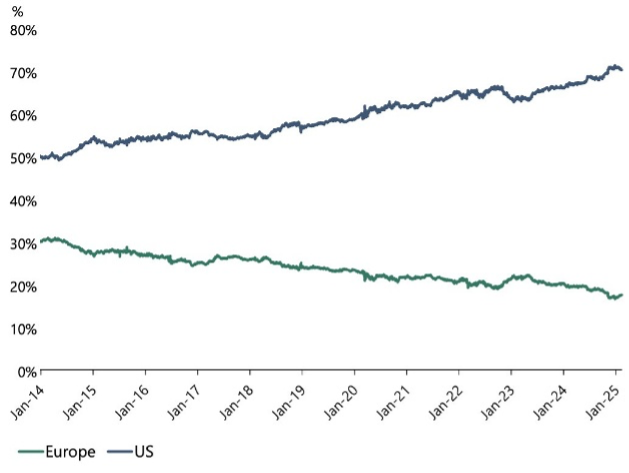
Figure: The US stock market has becoming increasingly important as a % of the total size of developed stock markets, whilst Europe has decreased. [1]
Even in the last week, there have been significant events. Firstly, President Volodymyr Zelenskyy of Ukraine’s ejection from the White House and alongside this the security guarantee from the US towards Europe. Next, the imposition of tariffs of 25% on imports from Canada and Mexico, and a further 10% for China. Finally, the suspension of military aid to Ukraine. These actions have potentially meaningful consequences – an appreciating US$ and inflationary pressure in the US and where impacted countries respond as a result of tariffs, rising geopolitical risks and the redirection of tax Euros to fund European defence spending at a significantly higher level.
Trump: pragmatist or ideologue?
The future path will be defined by the extent to which Trump is a pragmatist or an ideologue. He has long been viewed as the businessman and negotiator that loves to do the deal – the pragmatist that does what works. That is consistent with the rhetorical threat of tariffs to score policy concessions (e.g. increased border security in Mexico) or the removal of security guarantees to drive European defence expenditure. Although a blunt instrument, such threats seem to have been effective. The much greater problem arises if Trump is in reality an ideologue who is uncompromising and dogmatic in the pursuit of US exceptionalism. In this scenario, there is the risk of significant economic and market implications.
Our base case views Trump as a pragmatist – as the man who loves to do the deal and that has deep business instincts. In this scenario, Trump ultimately recognises that a prospering US economy and capital markets are central to his political success and the new world order that he aspires to create with a legacy that lives beyond his term. That said, the by-product of his recent actions is increased instability and uncertainty and that has now translated to increased volatility in equity markets at this time. As investors, these are times to hold tight.
The more significant consequences arise in the opposite scenario – if Trump is actually an ideologue pursuing making America great again irrespective of the consequences. Although this might be politically attractive – at least at a superficial level – the threat of inflation, lower corporate earnings growth, unattractive appreciation in the dollar and higher bond yields would be real and damaging. So we currently find ourselves in a paradoxical position. Trump may not abandon his desire for tariffs unless there is a sizable stock market sell-off, but the market may not fall significantly for as long as investors view Trump as a pragmatist rather than an ideologue.
Equities
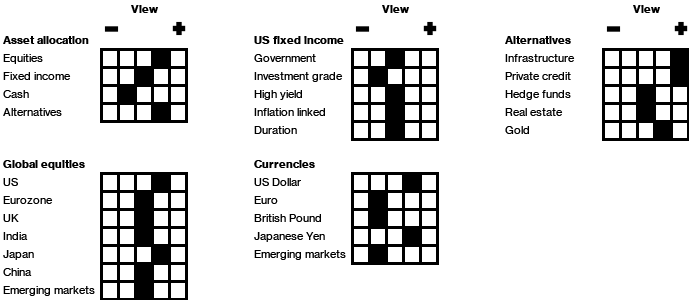
If we think about the rest of 2025, our base case sees resilient economic growth in the US and weaker but solid growth in other major developed economies leading to a stable overall economic picture. This sets a backdrop for continued upside in equities and a durable picture for fixed income. Provided President Trump adopts a pragmatic stance in relation to tariffs, we should start to see inflation weaken across the developed world leading to the possibility of interest rate cuts by the US Federal Reserve. Coupled with the continuation of tax reliefs and the possibility of tax cuts in the US and the potential for resolution of the Russia-Ukraine conflict, this would lead to a very positive environment for markets. Conversely, a tough ideological position on tariffs from Trump would undoubtedly lead to unwanted inflationary pressure and would be damaging to markets.
If our positive stance on the US economy proves correct, we anticipate continued upward momentum in US equities. This will likely be driven by the major technology players with their continued investment in the future of artificial intelligence. That said, the unprecedented focus on a small number of technology stocks is likely to broaden somewhat. In Europe, equity markets have already delivered a strong start to the year with the DJ Euro Stoxx 50 up over 10%. With signs that the stagnation in European economies is coming to an end and the potential resolution of the situation in Ukraine, this paves the way for further growth in equities with the technology, defence and real estate sectors offering particular opportunities.
In other markets, we are increasingly positive on Japan based on an improving economic picture and strengthening corporate earnings, alongside corporate governance reforms. In India, stocks have suffered from an economic slowdown, weaker corporate earnings and selling from foreign investors. We see this as a reasonable entry point for long-term investors. In China, geopolitical risks have not completely subsided, economic consumption remains subdued, and the impact of US tariffs is unclear. In this context, we see the greatest opportunity in technology and artificial intelligence related businesses.
Fixed income, currencies and alternatives
In US fixed income, we maintain a neutral stance on US Treasuries favouring short to medium-dated maturities. Over longer-dated maturities, rising geopolitical tensions and the prospect of persistent budget deficits could drive-up premiums in the near-term. During the last month, we have become increasingly concerned about the tightness of spreads over US Treasuries for investment grade bonds, observing that they are priced for perfection. With the current dislocation in equities markets resulting from Trump’s recent announcements, downside risk is increasing fueling our more cautious stance. In line with these perspectives, we would be reluctant to take undue extended duration risk in the current climate.
In currencies, we retain a short-term positive stance on the US dollar which will benefit from heightened trade tensions. We view the Japanese yen as likely to strengthen against major currencies with the Bank of Japan being the only significant central bank likely to raise rates this year. Gold remains firm with a new record high in mid-February, and we see continued central bank demand. We continue to view it as a relevant portfolio diversifier. We strongly favour well-sourced and diversified private credit opportunities, benefiting from the shift of risk off bank balance sheets and more attractive risk-adjusted returns versus high yield bonds. We also see significant opportunities in private infrastructure generally, and in particular where related to energy and technology. Attractive areas include infrastructure related to artificial intelligence, as well as data centres, telecommunications and decarbonisation.
For the reasons already mentioned, Geopolitical risk is high, and markets do not respond well to uncertainty. This is evidenced by elevated levels of the CBOE Volatility Index, a popular measure of stock market risk based on the volatility of derivatives linked to the S&P500 index. We believe that – in certain circumstances – there could be reasonable tactical trades that can benefit from this. For example, structured products that offer either an element of capital protection and/or higher coupons as a result of the volatility in markets.
But for investors in general who maintain a long-term investment horizon, we continue to believe that time in the market, not timing the market is the most coherent way to achieve good long-term returns. Do contact us to discuss your particular circumstances.
Nick Perryman is Vice Chairman at InCred Global Wealth Limited and Chairman of its Investment Committee. He has over 25 years of investment and wealth management experience, holds advanced qualifications in investment management, financial planning and psychology, and was previously a managing director at UBS. He is co-author of “Leadership in Wealth: Mastering the opportunities of wealth in your family, firm and society”
______
Footnote
[1] Source: Bloomberg, Apollo