
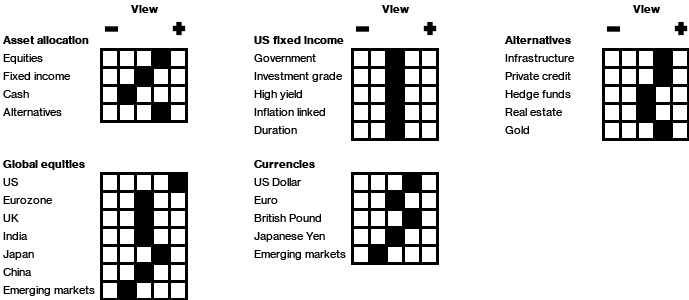
The start of 2025 has already been highly eventful – particularly so in the last week, with high profile developments in artificial intelligence and the imposition of US tariffs on trade with Canada, Mexico and China by President Donald Trump.
Events in the artificial intelligence world – OpenAI versus DeepSeek
Last Monday saw news that DeepSeek – the Chinese AI challenger to established players such as OpenAI – had delivered a near comparable AI model at a fraction of the cost. In reaction, we saw the stock price of NVIDIA – the leading supplier of hardware to the AI industry – drop by 17% wiping $600 billion off its value with $1 trillion off US technology stocks more generally. Over the week, questions over DeepSeek’s strategy/approach became apparent. DeepSeek itself stated that the final training run of its model had cost $6m – reported as a minuscule number in comparison to competitors – but this was actually only a small part of the total training process of its model. We will likely never know the true total cost of DeepSeek’s development, not least because it may wish to conceal its use of NVIDIA’s chips which would have been used contrary to US export restrictions. As testing of DeepSeek’s R1-model’s performance has occurred, it has become clear that it is not yet at the standard of its US competitors but what it has achieved is certainly notable. As President Trump said, it is a “wake-up” call for US firms. By the end of last week, much of the week’s losses across the technology sector had been reclaimed, with positive earnings announcements from three of the four so-called Magnificent 7 that reported results – Apple, Meta and Microsoft. Zuckerburg from Meta observed that DeepSeek’s fast progress in the development of its model pointed to the potential for beneficial efficiency gains in its own $65 billion spend on AI development in 2025. Events of last week illustrate that a broad-based approach to investing in AI is critical – it is our view that there will be many beneficiaries across the technology sector and beyond, and not just in the US. We introduce Capture the breadth of AI opportunities as a top investment theme below and see this as an optimal approach to investing in AI, beyond high concentrations to potentially volatile single companies.
Trump and tariffs
During all this action, President Trump’s rhetoric on tariffs on imports into the US significantly heightened. Last week started with the imposition of 25% (rising to 50%) US tariffs against Colombia. In the face of this threat, there was a climb down by Colombia, a day later, with them accepting the return of deportees on US military planes, in exchange for the reversal of tariffs. On Saturday, 25% tariffs against Canada and Mexico, and 10% tariffs against China, followed – although the Canada and Mexico tariffs have since been paused pending further negotiation. Trump’s objective is clear – he wants to support the US economy through increased purchasing of US produced goods. The negative by-product of such a move is inflation, owing to scarcity of skilled labour and sometimes even the absence of raw materials. The degree to which tariffs remain, or are increased, or are extended to other countries/trading blocs (e.g. EU) will be a key determinant of the outlook for the US economy and markets and will disturb an otherwise positive outlook. Even with the S&P500 back at near historic highs after last week’s volatility, our base case is positive for US equities with expectations of a continued positive earnings seasons, ongoing healthy economic growth and the potential for interest rate cuts by the Federal Reserve. However, with equity markets priced for perfection, President Trump needs to avoid actions that will give rise to inflation – sustained and punitive tariffs with a large number of key trading partners remain one of the great threats to the continuation of this positive outlook.
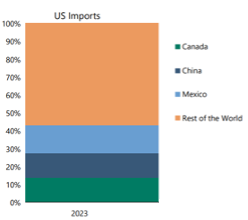
Figure: 43% of US imports come from Canada, China and Mexico – this means that 5% of US GDP is directly impacted by tariffs [1]
Beyond the US
In contrast, we maintain a mixed view on Europe. Companies will see only modest growth in earnings in 2025 – with uncertainty surrounding economic growth in many countries, a yet to materialize recovery in consumer confidence and the ongoing threat of US trade tariffs. That said, if President Trump is able to broker a similar peace deal in Ukraine to that in the Middle East, there is potential for disinflationary pressure with lower energy prices, and also German elections could yield a coalition with a more pro-growth agenda with the prospect of increased investment in infrastructure and innovation. We see some opportunities in the EU technology sector where valuations are less stretched and European real estate as interest rates fall.
We maintain a broadly positive stance on Japan equities, in the context of accelerating corporate governance reform and the prospect of higher returns on equity in Japanese companies this year, as well as increasing consumer spending. In emerging markets, as already highlighted, there is uncertainty around the imposition of tariffs on trade by the US, bringing additional risks to impacted companies. With US interest rate cuts set to take longer than originally expected, this will lead to continued relative US dollar strength, which is generally disadvantageous for emerging market economies. In India, recent market corrections provide a more attractive entry point into equities with the earning outlook looking solid – this, coupled with market reform, favourable demographics and stable governance make India a strong long-term opportunity. That said, the correlation between large-cap Indian stocks and the US market should be recognised – so scenarios that blow the US off course would lead to volatility in Indian equities, at least in the short term, although India will likely be insulated from US trade tariffs itself. The imposition of US tariffs on China further cements our neutral view – but China itself needs to focus internally on economic policies that boost consumption.
Fixed income, currencies and alternatives
We maintain a neutral stance on US fixed income overall. In US investment grade, credit spreads (versus government bonds) remain historically tight, and this represents a risk, but on balance we believe that this is reflective of a stable credit environment and that the total yield sufficiently rewards investors and provides a cushion against any spread widening that could occur. In the event of an economic slowdown, credit spreads would widen but compensation for this would come with the potential for interest rate cuts, thus supporting bond prices. Consequently, we view the risk-return relationship as attractive. In US high yield, credit fundamentals remain reasonable with low levels of default, although the risks for significant spread widening is greater. On balance, we see a more attractive risk-return relationship in private credit where we remain positive.
Coming into 2025, we have seen continued strength in the US Dollar (USD) as a result of positive US economic data, in contrast to other major economies. In our base case, we see US economic data remaining strong supporting continued USD strength. Even the imposition of US tariffs on trading partners would likely, in the near term, be supportive for the USD, although this would not necessarily continue as inflationary pressure increased.
Gold was strong in 2024, with a rise of 26%, its best performance in a decade, acting as a hedge against uncertainties in the world. For 2025, we see continued firmness in the gold price because of slower than expected US rate cuts coupled – in our base case – with an environment of decent US economic growth, with gold’s attractiveness supported by continued global geopolitical risk. We view gold as a counterbalance to uncertainty and a long-term hedge against future declines in the USD.
Reflections on economics and markets
As we have started 2025, I have been reflecting on my 25 years in markets and whether the current times are meaningfully different. I do think we live in notable times. The 47th President of the United States is ideologically in favour of US exceptionalism – making America great again – and the pursuit of that objective has economic consequences whether through tariffs on imports, deregulation, the deportation of immigrants or restricting the size of the state. The outsize influence of the US and its economy means that Trump’s actions will reverberate around the world.
“The 47th President of the United States is ideologically in favour of US exceptionalism – making America great again – and the pursuit of that objective has economic consequences whether through tariffs on imports, deregulation, the deportation of immigrants or restricting the size of the state.”
Then, there is the advance of technologies with seismic implications such as AI. I have heard it said – and I agree – that this is like 1997 with the advent of the internet/World Wide Web. We knew that something big was happening, but we did not know the precise implications. We could not have foreseen the ways our lives would be changed by Google, Facebook, YouTube, Amazon or Zoom. And so it is today – we are at a point in history of massive changes, things will certainly be different in five years.
But there is also what remains the same. I have not known a time when markets have not felt volatile or uncertain, or where there have been competing factors at play. It has never been risk-free to invest in equities nor has there ever been guaranteed excess returns. It has simply never been easy. What has always been the same is two key investment disciplines that have stood the test of time:
- Firstly, diversification across asset classes and geographies – as Markowitz, who won the Nobel Prize in Economics said, it is “the only free lunch in investing.”
- The second key discipline is to remain invested in markets to achieve the best long-term returns – time in the market, not market timing. The data is stark – investing in the S&P500 between 1994 and 2024, missing the best 10 days for returns would have led to 54% lower returns over the thirty-year period, and missing the best 30 days would have led to 83% lower returns. The data also tells us that 50% of the best 50 days for returns during that thirty-year period occurred during what would be termed “bear markets” (i.e. during periods of downward trend in markets). It pays to remain invested.
At InCred, we are here to independently and objectively advise you through these cycles – to act as your sparring partner as you make decisions about your wealth – and to guide you whether things really are the same or different.
Nick Perryman is Vice Chairman at InCred Global Wealth Limited and Chairman of its Investment Committee. He has over 25 years of investment and wealth management experience, holds advanced qualifications in investment management, financial planning and psychology, and was previously a managing director at UBS. He is co-author of “Leadership in Wealth: Mastering the opportunities of wealth in your family, firm and society”
_____
Footnote
[1] Source: Census Bureau, Haver Analytics, Apollo