
US Treasury Secretary, Larry Summers said “the dollar is like the English language: nobody particularly loves it, but everyone uses it.” And this is true for many of our clients. Most see the US dollar as the reference currency for their investment portfolios, many have businesses that regularly transact in US dollars, and some have real estate and business interests in the US itself. So, the US dollar is significant for them. With the recent declines in the US dollar and its central relevance for our clients, we discuss what might come next?
The context: The dollar is our currency, but it is your problem
Another Treasury Secretary, John Connally, said to European finance ministers, “the dollar is our currency, but it’s your problem.” And this is probably truer today than when it was said in 1971. Traditionally, the US dollar has been the global investor’s safe haven, trusted universally during times of uncertainty due to America’s political stability, strong institutions, and economic dominance. Yet, midway through 2025, this long-held status faces unprecedented scrutiny. The return of President Trump to office initially boosted investor optimism, lifting the dollar temporarily with expectations of pro-growth policies. However, a sudden policy pivot – marked dramatically by Trump’s unexpected and aggressive tariff announcement on 2 April – “Liberation Day” – triggered an abrupt reversal. The dollar dropped by more than 10% within weeks, underscoring growing investor uncertainty about the future stability of US policy and institutions.
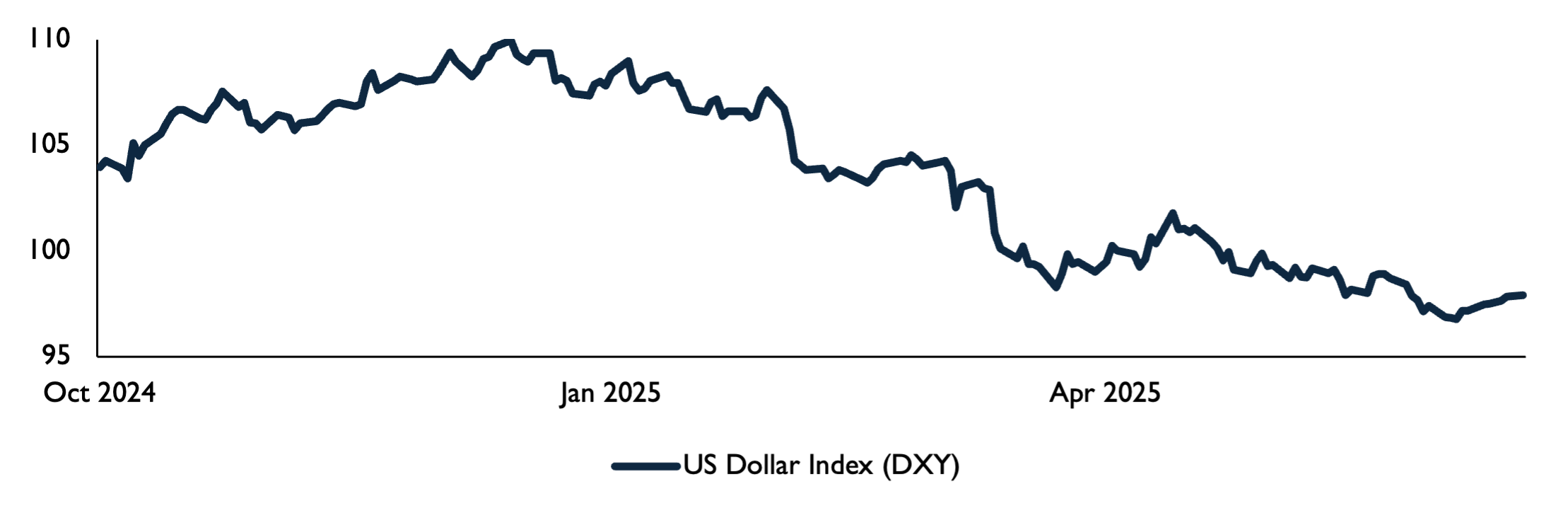 Figure: US dollar versus basket of major currencies (October 2024 – July 2025)
The US Dollar Index (DXY), which tracks the USD against a basket of major currencies, fell from 106 in early March to below 95 by mid-July—a decline of over 10%, marking its sharpest four-month drop since 2009. Today, entrepreneurs and investors globally are increasingly concerned, asking: Can the dollar maintain its dominant role as a reliable refuge during economic storms, or has a fundamental recalibration begun?
The causes
The return of Trump and policy unpredictability
Markets initially embraced Trump’s return, anticipating pro-business policies such as deregulation, tax cuts, and infrastructure investment. Yet optimism quickly faded due to his unpredictable governance style, epitomised by tariffs imposed on major trading partners ranging from 10% to an unprecedented 145%. These sudden measures introduced significant uncertainty, disrupting global trade relationships and deeply eroding international confidence in the US dollar. Investor sentiment towards the US has markedly shifted from optimism to caution. Capital that historically gravitated towards the dollar’s stability is increasingly flowing to other currencies and assets, diminishing the dollar’s traditional safe-haven appeal. This shift significantly impacts global trade and investment flows, affecting everything from international supply chains to asset allocation strategies. Investors, uncertain of future policy shocks, have grown increasingly wary, exacerbating market volatility. Unpredictability at the highest level of government undermines the consistency on which the dollar’s credibility has long rested. In past decades – such as during the 2008 global financial crisis or the COVID-19 shock – markets looked to the US for leadership and liquidity. In 2025, however, the source of volatility has become Washington itself. This has led to a weakening of the dollar’s safe-haven status. Alternative safe-haven assets such as the Swiss franc, Japanese yen, and particularly gold have consequently seen increased demand. Notably, central banks have accelerated gold purchases significantly in response to growing concerns about US fiscal management, debt sustainability, and threats to the Federal Reserve’s independence and prices have reached new highs. This is not just a hedge against inflation but a strategic repositioning away from reliance on the dollar-centric global system. For business owner, this has implications: suppliers in Asia may begin quoting prices in alternative currencies or adjusting contracts for volatility.
The twin deficits: a structural drag
At the heart of the dollar’s vulnerability lie US’s persistent “twin deficits”: a substantial trade deficit coupled with a rapidly escalating budget deficit. Recent fiscal stimulus measures, including extensive tax cuts and increased public spending, have inflated the US budget deficit, projected to exceed $1 trillion in 2025 alone. Simultaneously, US’s trade deficit remains considerable, as imports continually surpass exports by substantial margins. Together, the fiscal and current account deficits are approaching 10% of GDP in 2025, a level historically associated with downward pressure on the dollar, as seen in the late 1980s. Under normal circumstances, such deficits gradually weaken a currency. However, the combination of tariffs, policy unpredictability, and geopolitical tensions has intensified their negative impact. Foreign investors, crucial to funding these deficits, have become increasingly hesitant, reducing their demand for US Treasuries and assets, placing downward pressure on the dollar. History offers a warning: during the Reagan administration, a similar twin-deficit dynamic contributed to a 40% decline in the dollar over a two-year period (1985–1987). The current deficits are even more acute, yet coordination among global economic powers is absent.
Stagflation and the Federal Reserve dilemma
Tariff-driven inflation increases coupled with slowing economic growth have introduced notable stagflationary risks to the US economy. While a full recession remains unlikely within the next 12 months, inflation is notably higher than initial expectations, projected around 3% by year-end compared to previous forecasts of 2.4%. This economic scenario significantly complicates monetary policy decisions. As of July 2025, the market is pricing in 1% of Fed rate cuts by year-end. But it is a delicate balancing act: cutting rates sufficiently to support economic growth without exacerbating already elevated inflation levels. Rate cuts diminish the dollar’s yield advantage over other major currencies and will potentially lead to further downward pressure. Moreover, political pressures exerted on the Federal Reserve, including threats to its independence by the Trump administration, amplify uncertainty surrounding future monetary policy. This is a relatively new phenomenon for modern markets. Even during prior crises, the Fed’s independence was broadly respected. Undermining it introduces a structural risk into holding US assets – something investors cannot simply ignore.
Alternative currency dynamics: Euro, Swiss franc and Japanese yen
The challenges facing the dollar have accentuated the attractiveness of alternative currencies. The euro has notably benefited from relative policy stability within the Eurozone, appreciating steadily against the dollar to trade within the $1.15 – $1.20 range. Europe’s economic fundamentals remain robust, supported by structural reforms, proactive fiscal policies, and notably Germany’s expanded infrastructure and defence spending. Furthermore, European institutions have demonstrated predictable and stable governance, enhancing investor confidence. The trade-weighted euro has risen nearly 8% YTD, while the trade-weighted dollar has declined over 6%, a divergence not seen since the euro’s introduction.
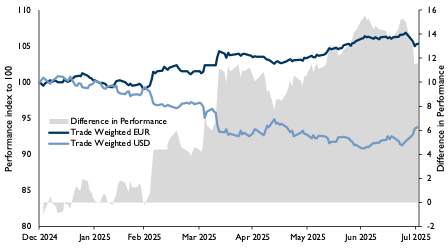
Figure: The relative performance of trade weighted US dollar and euro since December 2024
Similarly, the Swiss franc, often considered the ultimate safe-haven currency, has experienced robust demand, driving the USD/CHF exchange rate to multi-year lows around 0.80. Switzerland’s strong economic fundamentals, political neutrality, and policy predictability position the franc attractively during periods of heightened global uncertainty. The Swiss National Bank’s prudent management of monetary policy further bolsters investor confidence, cementing its status as a preferred haven asset. Japan’s yen also warrants attention. Though structurally weaker due to persistent deflation, it remains a counter-cyclical asset. In recent months, the Bank of Japan has signalled potential policy tightening, a reversal of decades of ultra-loose monetary policy. If realised, this would bolster the yen further. These dynamics reflect a broader shift in global investor preferences towards currencies underpinned by stable governance, predictable policies, and solid economic fundamentals – qualities currently perceived as weakened within the US.
Our recommendations
Balancing short-term stabilisation versus medium-term weakness
In the immediate short term, the US dollar may experience periods of stabilisation or minor recovery. Technical indicators suggest that the dollar is currently oversold, implying any positive news – such as trade tensions easing or unexpectedly strong economic data – could trigger brief rallies. US Commodity Futures Trading Commission data shows speculative net long positions in the euro have reached a two-year high, while USD net longs have reversed sharply, reflecting the shift in sentiment. Additionally, geopolitical crises – such as a flare-up in Taiwan or the Middle East – could momentarily revive safe-haven flows into the dollar. However, these would likely be tactical rather than strategic shifts. The broader fundamentals remain tilted against sustained strength. This is further evidenced by the April selloff, when the 30-day rolling correlation between gold and the dollar turned negative, to its lowest correlation in over a decade, suggesting a decoupling in traditional safe-haven flows away from the dollar. Our medium-term outlook therefore remains cautious. Structural economic issues, ongoing policy unpredictability, persistent twin deficits, and broader concerns about governance stability are expected to sustain downward pressure on the dollar. Absent a significant policy shift towards stability or a major external event that drives global capital back into US assets, we anticipate continued dollar depreciation over the next 6 –18 months.
Implications for business owners and investors in UK, UAE, India, Nigeria and Kenya
For many business owners and investors across these regions, the US dollar is more than a transactional medium – it functions as a benchmark for valuation, a hedge against local currency risk, and a core unit in cross-border trade, external borrowing, and asset allocation.
- In the UK, despite being a developed market with a free-floating currency, many businesses in commodities, trade finance, shipping, and private equity are structurally exposed to the dollar through invoicing practices, fund structures, or dollar-based investor mandates. A weaker dollar can erode revenue in real terms, complicate performance benchmarking, and prompt strategic rebalancing in treasury and investment allocations.
- In the United Arab Emirates, where the dirham’s peg to the dollar traditionally cushions businesses from FX volatility, a structurally weaker dollar can still erode global purchasing power. As the dollar depreciates against currencies like the euro or yen, import costs from Europe and Asia rise, and the relative attractiveness of USD-denominated assets may diminish in globally marked portfolios.
- In India, where the economy is deeply integrated with the dollar via energy imports, remittances, and external debt, rupee-dollar volatility continues to influence macroeconomic stability. The Reserve Bank of India has responded by diversifying foreign exchange reserves—including an increased allocation to gold and euro-denominated assets—signalling a broader intent to reduce vulnerability to US dollar cycles.
- In Nigeria and Kenya, where the naira and shilling are respectively floating or semi-managed, dollar weakness introduces both relief and complexity. On one hand, a softer dollar could ease inflationary pressures by lowering the cost of dollar-priced imports. On the other, it introduces planning challenges for businesses with dollar-linked contracts but local input costs – particularly in sectors such as consumer goods, logistics, and infrastructure development.
Across these regions, several common themes emerge for dollar-anchored businesses and investors:
- FX strategy is no longer optional: The traditional comfort of dollar stability is weakening. Businesses should consider hedging major procurement, capital expenditure, or external debt obligations – even if their local currency is formally pegged to the dollar.
- Portfolio diversification is prudent: Exposure to the euro, yen, gold, or commodity-linked currencies offers not just potential upside, but resilience in a multi-polar FX world. Non-dollar infrastructure assets may offer natural hedges.
- Understand second-order effects: A weaker dollar may benefit US exporters but hurt importers; it may ease foreign debt burdens but increase the cost of foreign inputs. These effects vary for each business owner or investor and need to be analysed.
- Review USD-denominated pricing power: For firms pricing in USD but sourcing locally, FX mismatch risk can widen if local currencies strengthen – undermining competitiveness or margins unless contracts are re-indexed or hedged. In this context, the dollar’s weakness is not merely a currency event – it’s a strategic inflection point for businesses whose cost structures, revenue models, or capital flows are dollar-dependent. Inaction may carry hidden costs.
Actions in your business and investment portfolio
In this context, an evaluation of currency exposure is critical for business owners and investors covering the following areas:
- Assessment of current currency exposure: What is the currency mix of your existing consolidated investment portfolio, across different institutions? What is the currency exposure across business assets, real estate and other assets?
- Assessment of future currency requirements: Are there known liabilities and/or income requirements in a particular currency and when?
- Decision on target currency mix: Given current exposure and future requirements, what is a reasonable current mix in a US dollar weakening environment?
- Implementation of currency strategy: In light of analysis, it may make sense to introduce an intentional hedging strategy for part of the US dollar exposure. This could involve currency forwards or options, structured currency solutions or using hedged share classes when buying investment funds. Historically, gold has also provided a hedge against a weakening US dollar.
Beyond this, there are certain specific actions that should be considered:
- Diversifying safe-haven exposure: Recognising the dollar’s reduced reliability as a safe haven, diversify into alternative assets including Swiss francs, Japanese yen, and particularly gold. Central banks’ increased gold purchases highlight its renewed strategic importance. Whilst at current prices, we do not suggest an overweight position in gold, we do recommend a full allocation.
- Capitalising on potential dollar weakness and volatility: Once you have discussed and agreed the appropriate non-US dollar exposure with your advisor – which is personal to you, based on your expected assets and liabilities in each currency, as well as your specific investment objectives and risk appetite – the next stage is discussing the strategy for implementing this exposure. A range of FX products can be employed:
-
- For immediate portfolio rebalancing, typically when the agreed strategic exposure is far from current allocation, a straightforward FX spot transaction may be most appropriate, to avoid the risk of sharp dollar weakness occurring before you have managed to accumulate the alternative currency.
- For more tactical positioning, with a view to accumulate further non-US dollar currencies if the US dollar strengthens over the short term, vanilla options offer this flexibility and potential.
- For sophisticated investors seeking to achieve more favourable rates than the current market, structured solutions such as FX accumulators can be considered. These strategies facilitate selling US dollars to buy alternative currencies at an enhanced rate, provided the market remains within a specified range. However, it is critical to understand that these more complex products carry specific obligations and risks. Sizing and suitability needs to be carefully considered.
- Revisiting supply chains and pricing: For business owners, a review of supply chains and pricing may be required, particularly where certain contracts are in dollars and others in local currencies.
Finally, it is wise to view every investment opportunity with a currency lens in mind – whether a portfolio investment or a real asset. If appropriate, proper assessment of the cost of a hedging strategy can then be assessed – and any return projections can take account of currency risk.
At InCred, we are here to support you with the analysis of the currency exposure in your investment portfolio or business, building a long-term plan. We are able to implement hedging strategies to create certainty in your position and offer investment strategies that reflect a particular currency view.
Nick Perryman is Vice Chairman at InCred Global Wealth Limited and Chairman of its Investment Committee. He has over 25 years of investment and wealth management experience, holds advanced qualifications in investment management, financial planning and psychology, and was previously a managing director at UBS where he was head of its international business in London. He is co-author of “Leadership in Wealth: Mastering the opportunities of wealth in your family, firm and society.