
Every market cycle brings a technology that changes how work gets done. Generative AI was like hiring a brilliant assistant – you ask, it drafts, it summarises, it answers. Agentic AI however is more like hiring a capable colleague who takes the goal, plans the work, uses your tools, and delivers the result for approval. Think of the difference between a chatbot that writes an email about a delayed shipment and a whole logistics system that re-routes the container, updates the customer and adjusts the invoice – all before you check its work. This shift from producing outputs to delivering outcomes marks the next stage of AI adoption.
In this report we explain what Agentic AI is, why it is arriving now, how it will change economies and businesses, and – most importantly – how to position portfolios so investors can benefit while controlling risk. We draw on a range of credible industry research and published academic research.
What is agentic AI?
A simple ladder helps.
- First, Generative AI: you ask; it writes (text, code, or images).
- Second, a basic AI agent: software that automates one task (checking an order, scheduling a meeting).
- Third, Agentic AI: software that coordinates many tasks to deliver an outcome – for example, resolving a customer issue end-to-end by pulling the right records, updating systems, and escalating to a person only for exceptions.
This diagram illustrates the journey from Generative AI to Agentic AI and the way that human input and decision-making is changing, with the rising autonomy of AI software:
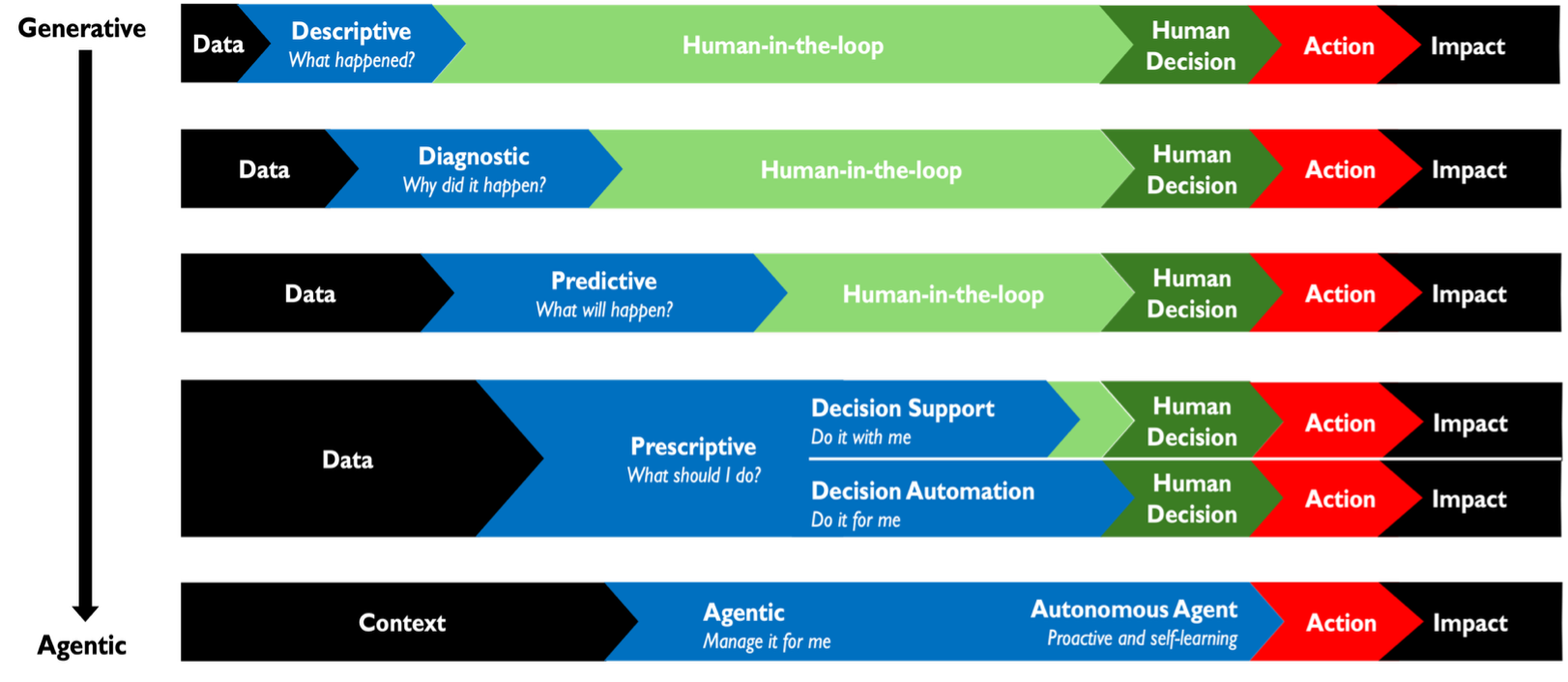
Figure 1: The journey from Generative AI to Agentic AI
Source: Adapted from slide of Björn Goerke (CTO, proALPHA) at ICG European Investor Day, 17 September 2025
Under the surface there is usually a large language model which acts as the reasoning and language engine. But the real difference is the orchestration: a plan of action, short-term memory of what has been done, and connections to company systems. Two new standards matter for scale: an Agent-to-Agent protocol that lets specialist agents collaborate safely, and the Model Context Protocol that gives agents controlled access to data and tools. Together they make multi-step work both possible and auditable. This matters because when software moves from assisting a step to finishing a job, the economic value expands hugely.
Why now – three forces pulling the moment forward
We observe three factors:
- Convergence: The real edge in AI no longer comes from which model you use, but from how well you connect it to the right data and workflows, so it actually gets work done.
- Reasoning: New approaches deliver longer, more analytical outputs that stitch together a full process, not just a single prompt.
- Proof: Enterprises now have credible results. In customer service, live deployments resolve around 60% of issues without a person, and rollouts are measured in weeks, not quarters. These are real contracts with outcome-linked pricing, not demos.
The proportion of enterprise software solutions incorporating agentic AI is forecast to grow significantly over coming years:
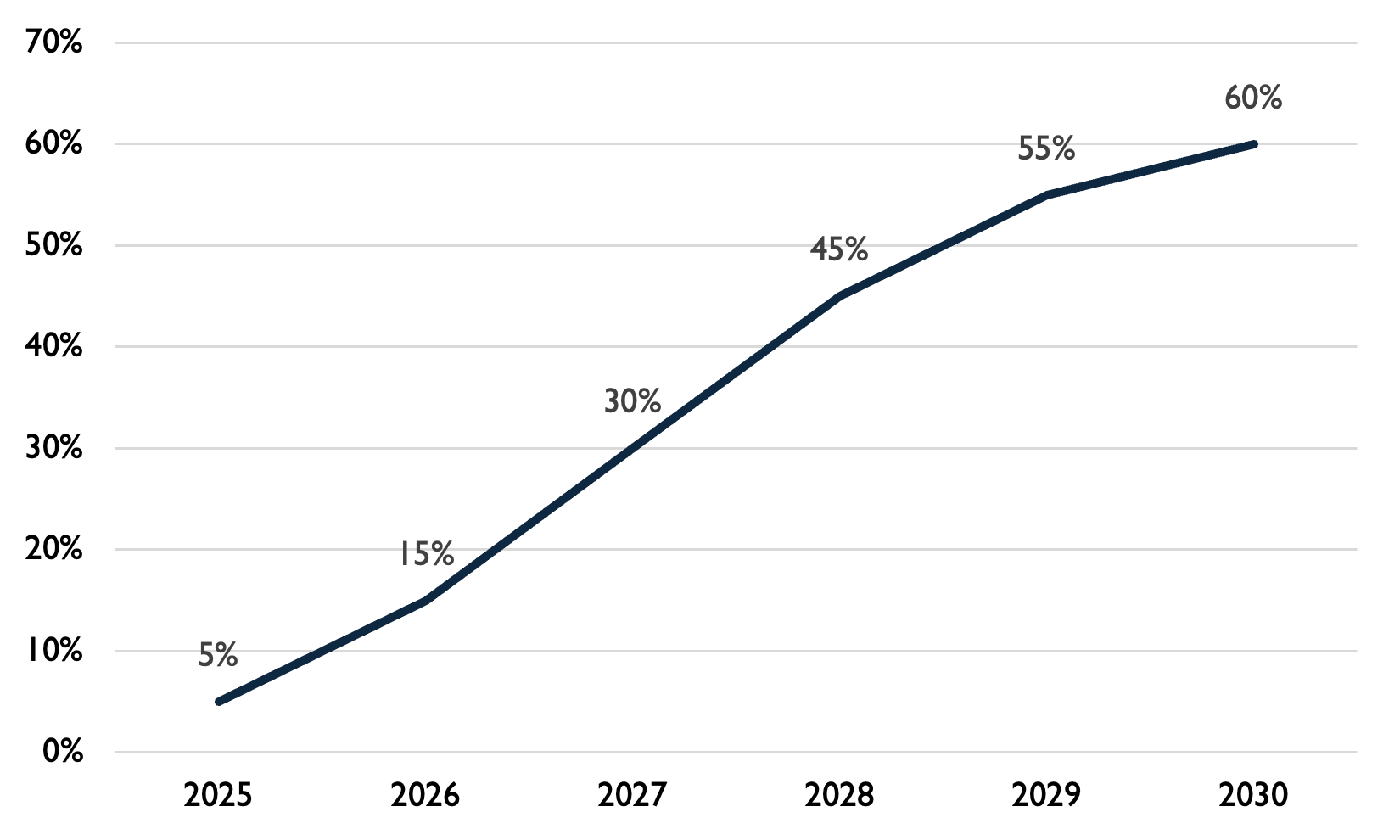
Figure 2: Forecast proportion of enterprise software solutions incorporating agentic AI
(Source: Goldman Sachs, July 2025)
What changes as systems become agentic
We see far-reaching implications across economies, workplaces and education, across industry sectors and impacting people in every stage of life:
- Economies – more done with the same people: Near-term gains land first where volumes are high and repetitive – service desks, logistics updates, simple back-office tasks. People who once worked the long tail of queries move into exception handling and process improvement, where the value is. The second-order effects come from speed to market and customer satisfaction: firms that respond faster tend to win share, especially when rivals are slow to adopt.
- Businesses – software budgets reshaped, rather than simply growing: In measured segments like customer service, Goldman Sachs estimates the total software market – traditional software plus agents – could be 20-45% larger by 2030 than it would have been without agents – and agents could be over 60% of that pool. The switch from seat-based to outcome-based pricing (per interaction or per resolution) is a key driver of this. For investors, that means looking beyond “who has the best model” to “who can prove value capture quickly, enlarging their share of it.
- Workplaces – the rise of the orchestrator: Work reorganises around human-in-the-loop orchestration. Individuals supervise small “flash teams” of agents that assemble around a goal, deliver, and disband. The day job becomes setting the goal and guardrails, reading the log, approving exceptions, and improving the system. This can raise productivity.
- Skills – fluency and judgement: The practical skills are orchestration (framing the goal correctly), data (connecting agents to the right sources), and evaluation (spotting failure early). Technical specialists will also focus on retrieval design, memory, and reinforcement learning – but everyone benefits from learning how to ask for outcomes, not outputs.
These capabilities are no longer theoretical – early deployments already show measurable productivity and financial impact.
What good could look like – five short case studies
We think it is helpful for investors if they can picture what this means inside a business they might own. The examples below show agents owning outcomes while humans stay in charge of policy and exceptions.
- Multi-region logistics business: A planner agent monitors port congestion and weather, re-routes containers hour by hour, and hands exceptions to an operations manager. A procurement agent secures back-up lanes within agreed rate caps; a customer agent offers revised delivery slots or partial credits where that is the best outcome; a cash-flow agent adjusts invoices to avoid disputes.
Key metrics impacted: on-time delivery higher; accessorial charges lower; “where is my order?” contacts lower; cash collected sooner (fewer days outstanding). - Specialty manufacturer (configure-to-order): A sales-engineer agent turns free-form requests for proposal into manufacturable bills of materials, checks plant calendars, and proposes realistic delivery dates. An inventory agent warns of component shortages and suggests equivalent parts; a quality agent reads shop-floor notes and flags drift from standard work. Sales operations and engineering keep final sign-off.
Key metrics impacted: quote turnaround time lower; on-time fulfilment higher; quality non-conformance issues lower. - E-commerce brand: A merchandising agent runs small, continuous tests of copy, bundles and pricing and quietly replaces under-performers. A service-and-retention agent resolves returns and exchanges inside chat. A fraud agent requests extra verification only where patterns suggest risk. Brand and risk teams set firm limits.
Key metrics impacted: conversion higher; preventable returns lower; chargebacks lower; customer satisfaction higher. - Regional healthcare provider: A scheduling agent matches clinicians, rooms and equipment to patient constraints and quietly re-books no-shows. A care-navigation agent assembles pre-authorisations and eligibility checks; a denials agent drafts appeals citing the right medical policy. Clinicians and revenue-cycle staff approve.
Key metrics impacted: no-shows lower; throughput on constrained modalities higher; avoidable denials lower. - Lender to small and mid-sized businesses: An origination agent pulls bank feeds, financial accounts and bureau data to propose terms; an identity-and-compliance agent completes know-your-customer checks, sanctions screening and anti-money-laundering monitoring; an early-warning agent watches cash-flow anomalies and sector signals and nudges outreach. Credit committees keep veto rights.
Key metrics impacted: time-to-yes lower; approvals within risk appetite higher; problem loans lower.
Investment implications and opportunities
Public markets
For listed equities, we believe durable opportunities sit in three layers:
- Enablers: Agentic workloads are longer and more complex than simple chat. That sustains demand for compute, high-speed interconnects and power. We favour chip designers and data-centre operators with cost and power-density advantages, and adjacent businesses in power generation, distribution, and advanced cooling solutions that make capacity possible.
- Data and orchestration platforms: As models converge, moats move to data quality and governance. Platforms that ground agents in a company’s own data, prove value in weeks, and provide observability and audit by default should command budgets across functions. Support for the new standards reduces integration pain.
- Application leaders: Incumbents with strong distribution and systems of record can defend – and extend – their position if they tie agent features to clear outcomes (faster time-to-resolution, revenue lift) and evolve pricing accordingly. Evidence of production use matters more than feature announcements.
A final category stands on its own and expands across all three layers: safety, observability and compliance. As autonomy rises, so does operational risk. Vendors that ship policy engines, role isolation, traceability and real-time evaluation as part of the product will be essential.
Private markets and direct co-investments
For investors who back managers and/or co-invest directly, three themes are particularly attractive:
- Outcome-priced applications: In customer service, revenue operations, developer operations/security operations and vertical software – where value shows up in resolution rates, cycle times, conversion and retention.
- Agent middleware: Evaluation and observability tools, memory, retrieval, and the connectors that make multi-agent orchestration reliable and auditable.
- Efficiency enablers: Software and hardware that reduce cost per resolved task and solve for power and cooling.
When evaluating co-investment opportunities, diligence should feel concrete: before/after metrics with quick time-to-value, credible access to proprietary or contractual data to shape model and processes, in-built governance in the product (audit trail, policy engine), and model-agnostic routing to control unit cost. A barbell approach could work well with perhaps 60–70% focused on “picks and shovels”, and 30–40% application winners.
Other investment considerations
Agentic AI is global, but four practical constraints shape winners in each region: power and connectivity, data governance, talent and services capacity, and capital access:
- North America – depth and velocity
Why: deepest pool of application vendors, toolmakers and buyers; hyper scalers spending drives demand for compute and power.
Own: chip designers; high-density data-centre operators; grid equipment and adjacent power generation, distribution and advanced cooling; software platforms that shorten time-to-value and interoperate via agent standards.
Watch-out for: power and interconnect bottlenecks; “AI features” without outcome metrics.
- Europe – the governance premium
Why: procurement favours auditable decisions, safety evaluation and traceability – exactly what turns agents into production systems.
Own: data and orchestration platforms that package observability, policy and audit “by default”; vertical applications in healthcare, financial services and industry.
Watch-out for: longer sales cycles; heavier integration. Outcome-linked contracts are a strong positive tell. - Middle East – advantaged power and sovereign demand
Why: energy economics and sovereign programmes support sustained data-centre and managed-services build-out.
Own (mostly private): greenfield/expansion data-centres, power generation/distribution, thermal management; managed services with compliance bundled.
Watch-out for: counterparty concentration; delivery risk. Structure for milestones and inflation-linked revenues.
Across Asia, there are three distinct stories:
- Japan – Why: reform and modernisation favour incumbents embedding agents in manufacturing and logistics. Own: application leaders with clear outcome metrics. Watch-out for: integration complexity in legacy organisations.
- India – Why: global delivery hub to operationalise multi-agent workflows; rising domestic SaaS. Own: services firms building evaluation/retrieval/policy practices and local SaaS priced to outcomes. Watch-out for: margin pressure if pricing tracks usage not outcomes.
- Singapore – Why: regional HQ, data-residency and rule-of-law. Own: regional data platforms and security/observability vendors. Watch-out for: higher operating costs.
Investors increasingly want progress and responsibility together. On environment, examine energy per outcome – for example, watt-hours per resolved task – not just data-centre efficiency statistics. On social factors, insist on re-skilling commitments, and human-in-the-loop policies for high-stakes processes. On governance, prefer vendors with ongoing safety and bias evaluations, incident logs, role-based access and audit trails built-in, and with board-level oversight.
What to watch out for next – five signposts
We recommend looking out for the following signposts:
- Outcome-based pricing becomes standard
What it is: Software fees shift from “per user” to per interaction or per issue resolved – and, in some cases, to a share of revenue uplift (for example, retention saved or upsell created).
Why it matters: Outcome pricing aligns incentives and signals that agentic products have moved from pilots to the profit and loss account. Early customer-service deployments already report about 60% resolution rates priced on this basis. - Standards in production (agents collaborating and accessing data safely)
What it is: Two interoperability standards move from trials to mainstream use: agent-to-agent protocols that let specialist agents collaborate, and a model context protocol that gives agents governed access to company systems and data – both with audit trails and policy controls.
Why it matters: Standards cut integration time, reduce failure risk, and make multi-step, multi-system workflows feasible at scale – the difference between a clever chatbot and a production-grade “finish the job” system. - Incumbent M&A and product convergence
What it is: Established software vendors acquire or tightly partner to bring agentic capability, governance, and data plumbing into the core of their platforms (for example, ServiceNow’s move to acquire Moveworks for agent connectivity and knowledge).
Why it matters: When incumbents put agents at the centre of their products – not at the edge – it confirms where they see the profit pool going: orchestration, evaluation, connectors, and outcome-priced applications. It also accelerates enterprise adoption by bundling capability into trusted platforms. - Front-office proof: agents that grow revenue, not just cut cost
What it is: Clear evidence that sales and marketing agents lift conversion, cross-sell, or retention, with those gains explicitly referenced in company reporting and customer case studies.
Why it matters: The market already recognises cost savings in service functions. The next leg comes when agents demonstrate top-line impact across the application layer, broadening the investment case beyond infrastructure. - Reasoning efficiency: lower cost per resolved task
What it is: The unit cost of finishing a job falls as vendors combine model routing (sending work to the cheapest capable model), smaller specialised models, and better tooling – offsetting the heavier compute needed for reasoning-led work.
Why it matters: Cheaper resolutions unlock new use cases and protect margins for vendors that price to outcomes. It sustains demand for compute and power while improving economics for data/orchestration platforms and application providers alike.
Conclusion: Agentic AI as the new frontier
Agentic AI marks the move from “type faster” to “finish more.” The economics are compelling, but they will not accrue evenly. Keep core exposure to enabling infrastructure; add selective weight to data and orchestration platforms; and build a thoughtful barbell of incumbent application leaders that are shipping agentic roadmaps and AI-native disruptors whose pricing and unit economics scale with value. Demand outcomes, insist on governance, diversify internationally, and hedge sensibly. That is how to harness this new AI frontier. At InCred, we have curated baskets of stocks, and selected leading managers that we believe can make the most of these investment opportunities. We work with you to construct portfolios with discipline and rigour that will evolve as these technologies advance. To help you, we have created a glossary of terms relevant to investors – see below.
About the author
Nick Perryman is Vice Chairman at InCred Global Wealth Limited and Chairman of its Investment Committee. He has over 25 years of investment and wealth management experience, holds advanced qualifications in investment management, financial planning and psychology, and was previously a managing director at UBS where he was head of its international wealth management business in London, and before that head of investment products and services. He is a doctoral researcher at Durham University and an honorary fellow of Royal Holloway, University of London. He is co-author of the book, “Leadership in Wealth: Mastering the opportunities of wealth in your family, firm and society”.
Appendix – Glossary of terms relevant to investors
A plain-language reference guide drawn from the main article. Each term includes why it matters for investors.
Agentic AI
Software that doesn’t just draft or answer questions but pursues a goal and finishes a job across multiple steps, using company data and tools, with people approving exceptions.
Why it matters: Moves pricing and value from “per user” to per outcome.
AI agent (basic)
Software that automates one task (e.g., checking an order or scheduling a meeting).
Why it matters: A building block – not the same as Agentic AI.
Agent-to-Agent (A2A) protocol
A method for specialist agents (service, finance, HR, logistics) to work together safely with clear hand-offs and scoped permissions.
Why it matters: Reduces integration cost and failure risk; enables cross-function workflows.
Application leaders
Established software vendors with strong distribution and systems of record embedding agentic features into core workflows.
Why it matters: They can defend – and extend – their footprint if they prove outcomes and evolve pricing.
Audit trail
A timestamped record of each agent action, data source and decision.
Why it matters: Compliance, trust, and faster enterprise procurement.
Barbell construction (in an investment portfolio)
Pairing durable “picks-and-shovels” (enablers and orchestration) on one side with higher-upside, outcome-priced applications on the other. Often ~60–70% / 30–40%.
Why it matters: Balances resilience and growth through non-linear adoption.
Cheapest capable model (model routing)
Sending a task to the lowest-cost model that can complete it accurately, reserving premium models for hard cases.
Why it matters: Lowers cost per resolved task; protects margins under outcome pricing.
Cost per resolved task
The all-in vendor cost to finish one job (not just tokens generated).
Why it matters: Core unit-economics metric for pricing power and profitability.
Customer satisfaction
Post-interaction measure of the customer experience.
Why it matters: Leading indicator of retention and brand health.
Data grounding
Forcing the agent to fetch facts from your systems first (orders, policies, contracts) before drafting or deciding.
Why it matters: Improves accuracy and reduces legal/reputational risk.
Data residency
Where data is stored and processed to meet local laws and policies.
Why it matters: Influences vendor selection and architecture by region.
Enablers
Infrastructure and platforms: computer chips, high-speed interconnects, power generation/distribution, advanced cooling, and data-centre capacity.
Why it matters: Demand rises as agentic workloads get longer and more complex.
Energy per outcome
Watt-hours to resolve one task (not just data-centre averages).
Why it matters: Decision-useful environmental metric for ESG diligence.
Exception handling
Cases that breach policy or risk limits (e.g., refunds above threshold).
Why it matters: Defines human–agent hand-offs and customer trust.
Finish-the-job system
A production-grade agentic system that completes a multi-step process end-to-end with audit, policy and approvals.
Why it matters: Where pilots convert into profit-and-loss impact.
Flash teams
Small, temporary teams (people + agents) that assemble around a goal, deliver, and disband.
Why it matters: Practical way work reorganises in early adoption.
Front-office proof
Demonstrated revenue impact (conversion, cross-sell, retention) from agents in sales/marketing.
Why it matters: Broadens the investment case beyond cost savings.
Governance (in product)
Capabilities built into software: policy engine, audit trail, safety tests, incident handling.
Why it matters: Speeds enterprise sales; reduces risk of roll-back.
Governance moat
A durable advantage built on superior controls – policy enforcement, traceability, safety/evaluation – embedded in the product and operating model.
Why it matters: Hard to copy; drives faster procurement and stickier deployments.
Ground truth / truth source
The authoritative internal data an agent must consult (e.g., order database, pricing table).
Why it matters: Ensures decisions match contracts and policy.
Human-in-the-loop
Defined steps where a person reviews or approves sensitive actions.
Why it matters: Safety, compliance and customer trust.
Interoperability
Agents and platforms connect easily to systems (e.g., ServiceNow, Salesforce, SAP), following common patterns.
Why it matters: Cuts integration cost; shortens time-to-value.
Large Language Model (LLM)
The reasoning and language engine behind many agents.
Why it matters: Necessary, but advantage increasingly comes from data, workflows and governance.
Model Context Protocol (MCP)
A controlled method for agents to access company systems and data with roles, permissions and logging.
Why it matters: Makes cross-function workflows compliant, auditable and region-aware.
Outcome-based pricing
Fees tied to an interaction or an issue resolved – and in some cases to revenue uplift (e.g., reduced churn) – instead of per-user licensing.
Why it matters: Aligns incentives; moves value from seats to outcomes; strengthens vendor margins when outcomes are proven.
Outcome rate (resolution/deflection)
Share of issues finished by the agent without a person.
Why it matters: Primary indicator of value creation and pricing power.
Picks-and-shovels
Shorthand for durable suppliers (compute, power, orchestration) that benefit regardless of which app wins.
Why it matters: Provides ballast in a barbell portfolio.
Policy engine
A control layer that enforces business rules in real time (refund bands, pricing limits, approval thresholds).
Why it matters: Prevents costly mistakes; reduces exception load.
Reasoning efficiency
The falling cost to finish a job through smarter routing, smaller specialised models and better tooling.
Why it matters: Expands viable use cases and protects vendor margins.
Safety and evaluation
Regular checks of accuracy, policy adherence, bias and robustness, plus testing and incident reviews.
Why it matters: Required by enterprises; de-risks adoption.
Standards in production
Agent collaboration (A2A) and model-context access (MCP) used in live customer deployments (not pilots).
Why it matters: Signals lower integration risk and faster scaling.
Systems of record
Core enterprise databases (customers, orders, finance, HR) that agents must consult and update.
Why it matters: Where accuracy, audit and business value come together.
Time-to-resolution
Elapsed time to complete a case (e.g., answer a claim, fix a shipment).
Why it matters: Ties directly to customer satisfaction and operating cost.
Time-to-value
Weeks from contract to first production impact, and to target outcome rate.
Why it matters: The single best filter for “demo” vs production; key to underwriting implementation risk.
Unit economics
How revenue and cost behave per job finished over time.
Why it matters: Determines whether outcome pricing leads to durable margins.
Sources
Acharya, D.B., Kuppan, K. & Divya, B., 2025. Agentic AI: Autonomous Intelligence for Complex Goals—A Comprehensive Survey. IEEE Access, 13, pp.18912–18940.
Argenti, M., 2025. We must prepare AI natives to shape the future of work. Fortune, 3 July. Reprinted by Goldman Sachs, 9 July.
Financial Times, 2025a. AI agents still need a human in the mix for legal tasks. Financial Times, 4 September.
Financial Times, 2025b. Rise of AI shopping ‘agents’ set to transform ecommerce. Financial Times, 31 August.
Goldman Sachs, 2025a. AI and US equities: The path forward for the AI trade. US Equity Views, 4 September.
Goldman Sachs, 2025b. Expert Network Series: Sierra on Agents & The Application Software TAM. Americas Technology: Software, 28 July.
Goldman Sachs, 2025c. Gen AI Part XIII: Takeaways from our 2nd Annual Silicon Valley AI Field Trip. Americas Technology, 21 August.
Goldman Sachs, 2025d. Generative AI Part XI: Agentic AI expands the App Software TAM. Americas Emerging Software, 16 June.
Goldman Sachs, 2025e. US Daily: A Primer on the Impact of AI on the GDP Statistics (Peng/Briggs/Dong). 13 September.
Hornyak, T., 2025. Agentic AI is here—but are we ready? Research-Technology Management, 68(5), pp.59–60.
InCred Insights, 2025. The Great Debate: Dot-Com Bubble 2.0? Implications for Investors Now. InCred Insights Special Report, 22 June.
McKinsey & Company, 2025a. One year of agentic AI: Six lessons from the people doing the work. September.
McKinsey & Company, 2025b. Seizing the agentic AI advantage: A CEO playbook to solve the gen AI paradox and unlock scalable impact with AI agents. June.
McKinsey & Company, 2025c. The future of work is agentic. People & Organizational Performance Practice, June.
Sapkota, R., Roumeliotis, K.I. & Karkee, M., 2025. AI Agents vs. Agentic AI: A Conceptual Taxonomy, Applications and Challenges. arXiv preprint arXiv:2505.10468.