
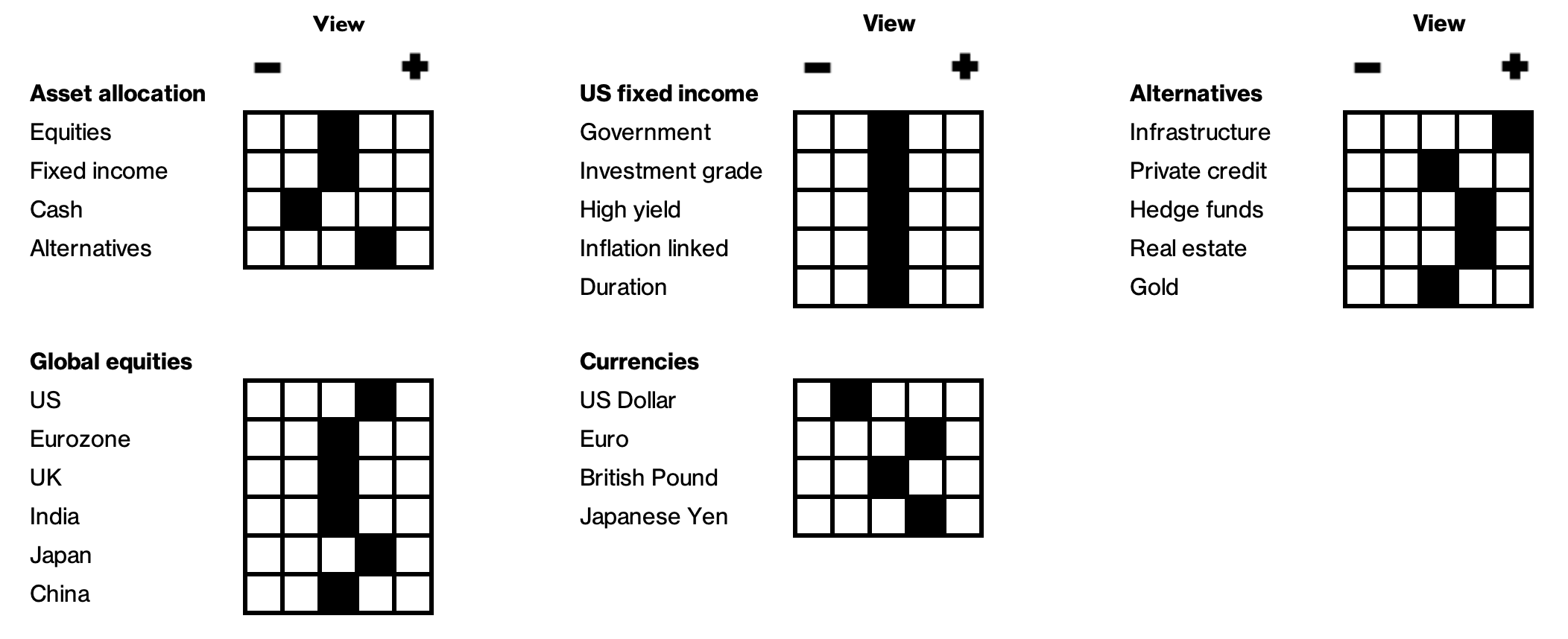
As year-end approaches, we have decided to adopt a more positive stance on US equities. The shift is incremental rather than bold, reflecting both the constructive factors underpinning the market and the clear risks that continue to lurk beneath the surface. This is not an “all clear” signal. Instead, it is a recognition that the balance of forces has tilted toward cautious optimism. We maintain that prudent risk management and diversification are absolutely critical in the current climate.
The US macro backdrop: policy support offsets weakness
The US economy has slowed. Job creation has cooled to levels barely above stall speed, consumer fatigue is evident, and tariffs continue to weigh on trade. Yet, the crucial point is that we are not seeing a recession. Instead, most forecasters expect a “soft landing”: slower growth but no contraction.
The Federal Reserve has already begun cutting rates, with expectations of a further 75–100 basis points of easing into early 2026. Importantly, this is a non-recessionary rate-cutting cycle, historically associated with strong equity performance. In past cycles where growth slowed but did not collapse, US equities delivered average 12-month gains of approximately 20% after the first cut.
Fiscal policy is also supportive. The One Big Beautiful Bill Act provides tax incentives for private sector investment in infrastructure, energy and technology. Combined with easier monetary policy, this creates a backstop for growth even as consumers retrench.
US earnings resilience: still surprising to the upside
The second pillar of our cautious optimism is corporate earnings. Despite widespread worries about tariffs and costs, US companies have delivered consistently strong results. In Q2 2025, S&P 500 earnings grew 12%, the third consecutive quarter of double-digit growth, with over 80% of companies beating estimates. Margins, far from collapsing, have actually improved in several sectors.
Consensus expectations are for S&P 500 earnings growth of 8% in 2025 and 7.5% in 2026. These figures are not heroic: they are achievable, and crucially they compare favourably with Europe, where earnings revisions have been consistently negative.
Earnings breadth is also improving. While the “Magnificent 7” technology giants remain dominant, financials, industrials, healthcare and capital goods have all delivered upside surprises. This broadening of the earnings story is essential if the market is to sustain its advance without becoming dangerously narrow.
AI and productivity: more than hype
Artificial intelligence remains the single most important structural driver for US equities. AI investment accounted for nearly one percentage point of GDP growth in the first half of 2025, and capital expenditure on data centres, semiconductors and applications continues at scale.
Sceptics argue that this is a replay of the dot-com bubble, with over investment and hype running ahead of reality. But there are critical differences. Today’s leaders – Apple, Microsoft, Alphabet, Nvidia – generate immense free cash flow and hold fortress-like balance sheets. Their forward earnings multiples, in the low 20s, are elevated but nowhere near the 50x valuations of 2000.
Crucially, AI is beginning to move beyond training infrastructure into inference – applications that generate recurring revenues. While risks of overbuild exist, the probability that AI delivers genuine productivity gains in the medium term is high. This underpins our constructive view.
US market valuations: expensive but not extreme
The S&P 500 currently trades at around 22 times future earnings, placing it in the 99th percentile of valuations over the past two decades. By almost any measure, the market is expensive. Yet expensive does not necessarily mean unsustainable – indeed, forward price-to-earnings ratio levels have been elevated for other periods over the last five years:

Figure 1: Forward price-to-earnings ratio based on analysts’ forecasts for the next four quarters, October 2020 to October 2025.
First, earnings growth justifies part of this premium. With earnings expanding at a high-single-digit rate, valuations can remain elevated as long as profits continue to grow. Second, when compared with other regions, US valuations are supported by stronger profitability and return on equity. Europe and emerging markets may appear cheaper, but they also face greater structural headwinds.
History shows that in late-cycle expansions equities can overshoot fair value, particularly when monetary policy is easing. We do not dismiss the risk of a correction, but we also recognise that valuations alone are not a timing tool.
US market sentiment: far from euphoric
One reason we are comfortable tilting slightly positive is that investor positioning is not extreme. Flows into bonds, money market funds and gold remain strong, while equity allocations have not reached the euphoric levels typical of bubbles. Goldman Sachs’ Risk Appetite Indicator, for example, is below historical peaks seen during the late-1990s tech boom.
Retail participation has increased, but institutional investors remain cautious. This creates scope for further equity upside if sentiment shifts, especially as buybacks continue to provide steady technical support.
US sector dynamics: more than just tech
Technology remains the headline driver, but opportunities extend across sectors. US banks are benefiting from low credit costs, modest deregulation, and renewed loan growth. Capital goods firms are well-placed to capture reshoring, automation and sustainability themes. Utilities are enjoying rising demand linked to AI-driven data centre growth. This sectoral breadth matters. A market carried solely by a handful of mega-caps is fragile; a market where multiple industries participate is more sustainable.
US risks: why we remain cautious
The decision to adopt a more optimistic stance on US equities to the year end is not without hesitation. There are five key risks:
- Tariffs and trade policy – higher effective tariff rates could squeeze corporate margins and consumer spending.
- Macro fragility – consumption remains two-thirds of GDP, and any acceleration in job losses would undermine the soft-landing narrative.
- Valuation vulnerability – at 22x earnings, any disappointment on profits could trigger sharp corrections.
- AI exuberance – if capex fails to deliver productivity gains, investor faith in the AI story could unravel.
- Geopolitical uncertainty – The US equity market has been resilient to geopolitical shocks so far, but risks remain elevated. Escalation in the Middle East, renewed tensions in the Taiwan Strait, or further disruption from Russia’s conflict in Ukraine could quickly feed into energy markets, supply chains, and investor sentiment. With valuations already stretched, equities may prove less able to absorb such shocks than in calmer conditions.
We therefore characterise our view as mildly positive rather than outright bullish. In this context, investors should retain hedges – gold, which has reached record highs, remains a useful stabiliser – and ensure portfolios are diversified across geographies and asset classes. In addition, we continue to favour the appropriate inclusion of structured products to optimise the risk-return relationship of equity exposure, as well as selected hedge fund strategies.
US fixed income: dependable income and smoothing
US fixed income is doing its job: delivering dependable income and smoothing the ride as the economy cools without stalling. To avoid big swings, we prefer mid-maturity bonds (roughly 5–7 years), which capture income without taking the heavy interest-rate risk of the very long end. Investment grade corporate bonds remain our core source of extra yield: company balance sheets are generally sound, all-in yields are still appealing by recent standards, and medium-dated bonds help balance income, quality, and liquidity. High yield can play a role, but we keep it measured: fundamentals are acceptable, yet valuations leave less room for error, so we focus on higher-quality segments and shorter maturities for carry without the additional risk of holding longer dated maturities. For inflation protection, a modest allocation to inflation-linked can be a useful hedge if price pressures prove sticky, and current market pricing makes them a reasonably priced insurance policy. Overall, we keep duration near neutral, centred in those mid-maturities, letting quality credit do most of the work while Treasuries provide ballast—we believe this fits a late-cycle, easing-but-not-recessionary backdrop.
US dollar: continuing to edge lower
As previously stated, the US dollar should edge lower over the next year as Fed rate cuts chip away at its income advantage and global investors trim outsized US dollar positions. Against the euro, a narrower policy gap and steadier European backdrop argue for a slow euro-dollar climb. For sterling, we expect more modest dollar losses – higher UK interest rates help, but uneven growth and fiscal uncertainty cap sterling’s upside. The bigger swing is likely in dollar-yen. Japan is gradually normalising economic policy as US yields ease, tilting dollar-yen lower over time. Net-net, we see a measured dollar downtrend, not a complete collapse; we lean long euro, are more cautious on sterling, and would build yen on weakness into rallies.
And equities in the rest of the world…
We see the backdrop for Europe quietly improving – falling inflation, easier monetary policy and upcoming fiscal programmes put the region in a rare “sweet spot”. We prefer selective exposure – for example, mid-caps positioned for Germany’s fiscal shift, defence, and energy upgrades – rather than broad beta.
For China, we remain selective – targeted stimulus and policy pragmatism have trimmed tail risks, yet weak domestic demand and export-driven deflation argue for patience. We favour strong, profitable leaders in government-supported areas (AI build-out, advanced manufacturing, EV parts, and staple consumer names) and avoiding debt-loaded or property-exposed companies.
India’s multi-year story is still strong: more activity is moving from cash to digital channels, the state is investing heavily in roads, rail and power, and global manufacturers are increasingly establishing a physical presence. But a lot of is already priced-in, so we favour adding on pullbacks – especially in well-capitalised banks and insurers, and the companies that drive infrastructure – rather than chasing extended valuations.
Japan remains our preferred market. Companies are being pushed to deploy capital better – with more independent boards and tougher listing rules – and they are responding with stronger returns on their equity, more buybacks and more ordered balance sheets. A gradual, well-signalled shift by the Bank of Japan away from ultra-easy monetary policy helps banks and encourages discipline without choking growth. Valuations are still clearly less expensive than in the US, and with earnings stabilising and policy likely to stay consistent, we favour solid, cash-rich cyclicals, financials, and companies linked to the build out of infrastructure.
Gold: maintain a full strategic weighting
We continue to advocate holding a full weighting to gold in portfolios. Gold remains the simplest, most liquid hedge against a mix of risks that conventional assets don’t fully catch – policy error, structurally high public debt, and episodic geopolitical shocks. With the Fed easing into 2026, the two variables that matter most for gold – real yields and the US dollar – look more likely to drift lower than higher.

Figure 2: Gold price in USD, September 2015 to September 2025
What keeps us positive on gold?
First, demand is doing heavy lifting. Central banks are diversifying reserves in a world that feels less predictable. There has been robust buying in 2025, near last year’s pace and a renewed pick-up in ETF flows – both consistent with a market where dips should be used to optimise allocations.
Second, gold’s usefulness is not a myth. Whilst it is not a perfect hedge against slow-bleed inflation, it is a shock absorber when inflation or geopolitics jump unexpectedly and when bonds wobble. Across multi-asset studies, gold’s low correlation with other asset classes improves risk efficiency in portfolios and softens portfolio drawdowns – particularly in equity-led sell-offs or inflationary scares.
Third, the macro environment remains supportive. If real rates grind down and the dollar weakens as policy normalises, that’s a tailwind for bullion. We’re also mindful that gold’s “political neutrality” matters more in a fragmented world: it is not tied to any single sovereign’s balance sheet or legal jurisdiction, a point that has become more salient after recent reserve freezes.
Finally, gold is jurisdictionally neutral. Whilst owned by sovereigns, it is a non-sovereign asset – it is not the liability of anyone. Therefore, it can be held outside any single legal system, reducing exposure to policy risk, sanctions and capital controls.
What are the risks to the gold price?
In our opinion, the risks are clear and manageable. These include:
- An upside surprise to US growth that lifts real yields and the US dollar.
- Geopolitical de-escalation, compressing the perception of risk in the world.
- Reductions in exposure via exchange traded funds and futures after a strong run.
None of these undermine the strategic case, but they argue for disciplined analysis of an investor’s asset allocation and rebalancing as appropriate.
Where could the gold price go?
Whilst we do not anchor our thesis on gold to significant rises in value, it is helpful to survey perspectives on price (per oz) from other houses:
- UBS sees $3,900 by mid-2026 based on central bank buying and softer real rates.
- JP Morgan argues for $3,600–3,700 for year-end 2025 and $4,050–4,150 by mid-2026.
- Julius Baer flags the potential for the price to exceed $3,500 into year-end 2025 on a mix of safe-haven demand, reserve diversification, and a weaker US dollar.
- Goldman Sachs forecasts $4,000 by mid-2026 through a combination of central banks, exchange traded funds and speculators, as well as support from households in emerging markets.
Read these as signposts which underline that – absent a sharp reversal in real rates and the dollar – the skew remains to the upside over our horizon.
Gold: own it and size it appropriately
Our bottom line: own it, and size it appropriately. Gold is portfolio insurance – it pays for itself when uncertainty is highest. We therefore continue to advocate a full strategic holding with periodic rebalancing as appropriate. Exposure can be achieved through direct holdings and exchange traded funds, as well as structured products that can achieve differing risk-return pay-offs. FX risk needs to be assessed in an overall portfolio context. For larger mandates we diversify custody across jurisdictions and providers and insist on allocated and unencumbered bars with regular audit.
Private markets: manager discipline is key
Private infrastructure remains our preferred private market engine: regulated utilities, concessions and digital networks (power grid, fibre, data centres) pay contractual, often inflation-linked cashflows, with policy tailwinds from decarbonisation and energy security. We like managers who can improve assets, not just own them. Private real estate is turning more interesting after broader repricing. We focus on cash-generative, supply-constrained segments – logistics, data-centre shells, select residential and life-science space – where lower financing costs and limited new build support rents. We are more cautious on private credit. Yields look attractive, but competition is compressing spreads, terms are loosening at the margins, borrower quality is mixed, and marks to market can lag reality. Our stance: favour senior, asset-backed loans with covenants and strong sponsors; avoid stretch-leverage, cyclical sectors and loan-to-own scenarios. Across all three, we prize manager discipline, alignment and access to proprietary deal flow.
Conclusion: constructive but not complacent…
We end the quarter constructive but not complacent. In equities, we tilt modestly positive on the US as policy eases and earnings stay resilient, while Europe quietly improves and Japan remains a preferred developed market. Bonds continue to do their job: mid-maturity duration for stability, quality credit for income. Over time, the US dollar should edge lower, favouring the euro and – selectively – yen. We maintain a full strategic holding in gold as portfolio insurance in a world of high indebtedness and episodic shocks. In private markets, we prioritise contracted cashflows (infrastructure), repriced, supply-constrained real estate, and remain selective in private credit with an emphasis on senior, asset-backed risk. At InCred, we are here to guide you in this complex environment – ensuring that your investment strategy is robust, and appropriately diversified.
About the author
Nick Perryman is Vice Chairman at InCred Global Wealth Limited and Chairman of its Investment Committee. He has over 25 years of investment and wealth management experience, holds advanced qualifications in investment management, financial planning and psychology, and was previously a managing director at UBS where he was head of its international wealth management business in London, and before that head of investment products and services. He is a doctoral researcher at Durham University and an honorary fellow of Royal Holloway, University of London. He is co-author of the book, “Leadership in Wealth: Mastering the opportunities of wealth in your family, firm and society”.