
Executive Summary
- Davos does not decide outcomes: No binding policies are set and no capital is allocated. Its relevance lies in what it reveals about how governments and large institutions now expect economic stress to be handled, and where losses are assumed to sit when trade-offs become unavoidable.
- Davos is not signalling new policies, but the routine use of government intervention: Tools such as trade restrictions, regulation, licensing, and conditional market access are no longer framed as temporary responses. They are treated as normal instruments of policy, including within relationships previously assumed to be stable.
- Economic risk is migrating from markets to institutions: Outcomes are increasingly shaped by jurisdiction, regulation, and policy discretion rather than by growth alone. Undifferentiated global exposure is less reliably rewarded than in the past.
- High government debt is now treated as a permanent condition: Policy discussions focus on managing debt over time rather than resolving it outright, implying greater emphasis on real purchasing power, liquidity, and adaptability than on nominal performance.
- AI is discussed as infrastructure, not just opportunity: While corporate adoption and productivity gains continue, the economics of AI differ sharply across the value chain. Capital tied to underlying infrastructure behaves very differently from capital exposed to competitive software and application layers.
- For wealthy families, the risk is not being wrong on forecasts but being exposed to rule changes: What matters most is where a change in rules, access, or permissions would be felt first, and whether a shift in one jurisdiction could force decisions across the rest of the balance sheet.
Introduction
The World Economic Forum in Davos does not change rules or allocate capital. Its relevance lies elsewhere. It reveals how governments, regulators, and large institutions now expect economic stress to be handled, and where they assume losses will sit when trade-offs become unavoidable.
What distinguishes recent Davos discussions is not that new tools have emerged. Many of the policy instruments now in focus have existed for decades. What has changed is how routinely and openly they are used, including within relationships that were previously assumed to be stable. The emphasis has shifted from rebuilding a stable global framework to accepting a more fragmented one and managing outcomes within it.
For wealthy families, Davos is not a source of instruction. It is a signaling mechanism. It shows which assumptions are still safe, which are being quietly retired, and which risks are now treated as acceptable collateral damage. That distinction matters.
One way to make this shift visible is to step back from individual speeches and look instead at how the same core economic questions are now being framed differently.
How assumptions reflected at Davos have shifted
This table summarises the dominant framing visible in Davos discussions, not every view expressed. It contrasts earlier assumptions with the logic that now increasingly shapes policy and capital behaviour.
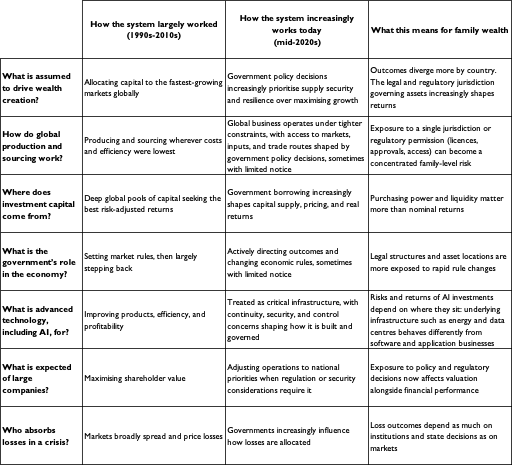
Government intervention and changing rules now shape how the system works
Read this way, Davos signals a shift in how economic relationships are now expected to function. What is increasingly visible in discussions is that trade, market access, and regulatory alignment between major blocs that were once treated as stable are now being actively questioned, renegotiated, or made conditional. This includes relationships such as the US-EU trading framework, US-China technology and market access, and energy and industrial policy coordination even among long-standing allies. These developments are no longer framed as temporary disruptions to be smoothed away, but as structural features that must be managed.
Trade, tariffs, regulation, market access, and licensing are discussed by policymakers as routine tools of policy rather than as emergency measures. They are used not only in response to crises, but as standing instruments to influence behaviour, shape supply chains, and protect strategic interests. Growth is no longer framed as something to be maximised in isolation, but as something to be balanced against security constraints and other policy objectives.
The economic mechanism is straightforward. Securing supply, duplicating capacity, and complying with diverging rules increases the amount of capital required to produce the same level of output. Efficiency gives way to redundancy. Activities that were once organised around cost and scale are now organised around assurance and resilience. Economic relationships that were previously assumed to be durable become conditional on continued alignment.
For capital, this changes where risk sits. Undifferentiated global exposure is less reliably rewarded, while jurisdictional and regulatory risk increasingly shapes outcomes alongside fundamentals. The issue is not ownership, but dependence. Assets, businesses, and cash flows that rely on stable access to specific markets, permissions, or regulatory frameworks carry a different risk profile from those that do not.
This assessment would change if there were credible signs of renewed coordination or binding limits on the routine use of trade, regulatory, and access-based policy tools. Davos offers little evidence of either.
High government debt is now treated as a permanent condition
A second signal emerging from Davos discussions concerns how governments now expect to live with high levels of debt. Sustained borrowing is treated less as a problem requiring resolution and more as a condition to be managed over time. In policy conversations, there is little emphasis on rapid debt reduction and much more on mechanisms that allow debt to persist without forcing abrupt adjustment.
Adjustment is assumed to occur gradually, through a combination of growth, inflation, regulation, and financing conditions, rather than through discrete fiscal repair or restructuring. This reflects a shift in planning assumptions, not a denial of the scale involved.
Global government debt is approaching 100 percent of GDP overall, with many advanced economies already well above that level. Relative to the magnitude of the burden, this now attracts limited urgency in Davos discussions, which focus more on near-term growth narratives and sectoral opportunities than on how such debt is ultimately worked down.
This does not imply uniform outcomes. Some countries will consolidate. Some will grow out of part of the burden. The point is that, system-wide, the dominant base case being signalled is that high government debt will persist rather than be decisively reduced.
For wealthy families, the implication is not alarmism but a change in emphasis. Nominal returns matter less than purchasing power. Liquidity, flexibility, and the capacity to adapt to changing conditions matter more than headline performance in an environment where debt is treated as permanent rather than transitional.
AI as infrastructure, not just opportunity
Artificial intelligence deserves separate treatment because it is no longer framed primarily as a productivity story.
At Davos, AI is discussed as critical infrastructure. The build-out is global, but it is increasingly shaped by security, energy availability, regulatory constraints, and state influence. Continuity and control now sit alongside innovation.
This does not negate corporate adoption or productivity gains. It does mean that the economics of AI are uneven across the value chain. Capital tied to underlying infrastructure behaves very differently from capital exposed to competitive software and application layers.
Understanding where exposure sits matters as much as believing in the technology itself.
What Davos is not emphasising
Less visible in Davos discussions is sustained focus on how today’s economic constraints interact under stress. Across governments and financial systems, debt levels are already high, balance sheets are extended, and the capacity to absorb shocks without side-effects is more limited than in previous cycles.
In practical terms, governments carry large debt burdens, central banks hold expanded balance sheets, and banking systems operate with less headroom to absorb losses before confidence becomes an issue. At the same time, the scope for policy response is narrower. Interest rates are no longer near zero, inflation remains politically sensitive, and further large-scale fiscal expansion carries visible trade-offs.
Relative to near-term growth narratives and sectoral opportunities, these interacting constraints receive less emphasis in public Davos sessions, even though they shape how crises ultimately unfold. The tension is implicit in the structure of current policy choices, even when it is not addressed directly.
For capital, this matters because it changes how risk arrives. The danger is not slow deterioration, but non-linear adjustment. When tolerance thresholds are crossed, responses tend to be abrupt. Rules change quickly, liquidity can disappear, and losses are redistributed in ways that are not smoothly priced in advance.
What this means for wealthy families
The central question for wealthy families is no longer simply where returns appear most attractive. It is where the rules governing those returns can change most quickly, and where the state has the ability to reshape outcomes regardless of underlying economics.
In practical terms, this means understanding which assets and cash flows depend on continued access, permissions, or favourable treatment. These include exposure to specific tax regimes, regulatory licences, market access, currency convertibility, and the availability of liquidity in stressed conditions.
A useful diagnostic is to ask where a change in rules would be felt first. Would it arrive through taxation, regulation, access to markets, capital controls, or funding conditions?
What matters is not predicting which rule will change next but recognising whether a change in one jurisdiction could force decisions across the rest of the balance sheet. Where that linkage is tight, risk is higher than headline returns alone would suggest.
Reading Davos correctly
The right response to Davos is not action. It is interpretation.
Ignore the speeches and the theatre. Watch which assumptions are being normalised. Notice which trade-offs are accepted without apology. Pay attention to what is no longer treated as a problem.
Davos does not tell wealthy families what will happen. It tells them how the world’s most powerful actors now expect economic pain to be distributed when it does.
That is why it still matters.
About the author
Nick Perryman is Vice Chairman at InCred Global Wealth Limited and Chairman of its Investment Committee. He has over 25 years of investment and wealth management experience, holds advanced qualifications in investment management, financial planning and psychology, and was previously a managing director at UBS where he was head of its international wealth management business in London, and before that head of investment products and services. He is a doctoral researcher at Durham University and an honorary fellow of Royal Holloway, University of London. He is co-author of the book, “Leadership in Wealth: Mastering the opportunities of wealth in your family, firm and society”.