
“Liberation Day” has come with President Donald Trump announcing far reaching tariffs on imports into the US. From the White House Rose Garden, he invoked a baseline tariff of 10% on imports from all countries and reciprocal tariffs on specific nations who have imposed high tariffs or other barriers on trading with the US. For example, this means a rate of 20% on the EU and – with the tariffs already announced – a 54% rate for China. Across the board, it represents a staggering 10x increase. Whilst there are exclusions for certain sectors and types of goods, this new policy is far reaching and will have a meaningful impact on politics, economics and market
What might happen next?
The one certainty is likely to be uncertainty. The leaders of the most impacted countries may want to negotiate, some will retaliate. Pressure will be applied by lobbyists representing disadvantaged industries. There is also the possibility of legal challenge to Trump’s executive authority in this area. On Bloomberg Television, US Treasury Secretary, Scott Bessent stated that the tariffs being imposed are at “the high end” and that interventions from individual nations could reduce them. But none of this can be fixed overnight.
Whilst our base case is for an equilibrium to be reached, there will be some more immediate consequences – and this has already started to appear in the data. We expect this to be a driver of US economic uncertainty with weaker business and consumer sentiment, and ultimately a lower level of economic growth. Higher production costs will lead to higher prices which will be reflected in the inflation data. Even using the Fed’s own model, core US inflation could rise by an additional 1.4% and the US GDP hit could be in excess of 2% if this plays out in the long term. All of this will lead to an impact on the earnings of US companies and non-US businesses with substantial US exposure, especially those that import goods into the US.
As expected, the reaction from equity markets has been negative with compensatory rises in bond prices as investors respond by adopting a more cautious stance. The CBOE Volatility Index (VIX), a popular measure of volatility in the S&P500 index, is at elevated levels and at the time of writing was higher by 16% today.
How to invest in uncertain markets?
Uncertainty is undoubtedly heightened, but opportunity does not disappear. The first question is one of time horizon. Is your time horizon longer than a presidential term or a recession should one arise? (and it may not). Amongst our clients, the answer is invariably yes and combined with diversification, time in the market not market timing will be their driver of long-term returns. That said, there are opportunities to make the most of the current environment.
The first question is one of time horizon. Is your time horizon longer than a presidential term or a recession should one arise? (and it may not).
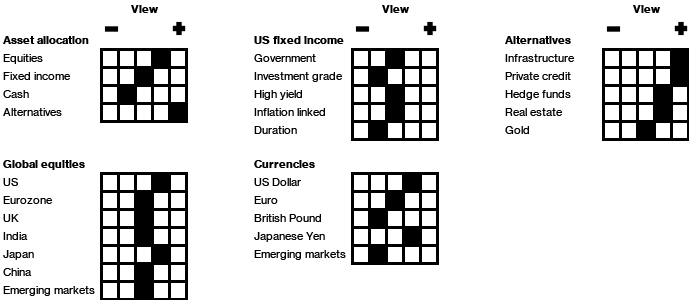
Our base case remains favourable for equities – certainly when adopting a year end perspective – but we accept that significant immediate upside in US equities is unlikely. As already stated last month, we therefore remain strong advocates of structured products that make the most of heightened volatility, either capping upside or offering a defined coupon payment, in exchange for at least some downside protection. The current pricing of such products offers the possibility of high single digit returns over the next year. Such solutions potentially provide a better risk-adjusted profile for investors seeking to enter the market and the opportunity to realise gains for those already invested.
Diversified global equity exposure is also critical, and we have for some time advocated a full allocation to European equities. Whilst the precise impact of tariffs on the EU is not yet known, there are structural changes in Europe that are attractive – such as seismic changes in defence spending and the pro-investment agenda of the new German government – as well as ongoing valuation mismatches in particular sectors versus US equivalents and the possibility of peace in Ukraine. Progress in the European manufacturing and service sectors is underlined by the recent eurozone Purchasing Managers’ Index survey, which was at its highest level for 26 months. We continue to favour European companies that will benefit from infrastructure investment such as in the materials sector, then real estate and small-midsized capitalisation companies that will gain most from domestic growth and are best protected from US tariffs. With profit margins growing in the financial services sector, certain banks and asset managers are attractive but it is essential to be selective.
Opportunities in assets with lower correlations
For some time, we have been strong advocates of alternative asset classes with lower correlations to public equity markets. Even before the announcements of “Liberation Day” we had resolved to upgrade our stance on private infrastructure and private credit to most preferred. For investors who can withstand long-term illiquidity, we believe that these asset classes offer a favourable risk-return relationship and can act as a useful diversifier within a portfolio context.
Private infrastructure generally offers investors inflation protection with revenue streams that are index linked and locked in via long-term contracts, thus providing considerable stability during periods of market volatility. In particular, we see a boom in digital infrastructure driven by AI and cloud computing demands, as well as fiber networks and telecommunications infrastructure. It is estimated that the financing gap could be as large as USD 94 trillion between now and 2040. Like with public equity market opportunities, Europe offers some particularly favourable opportunities at present.
Private credit as an asset class has benefited from a structured shift away from banks as primary lenders to businesses, as a result of banking regulation – put simply, the increases in the capital that banks must hold when lending has increased significantly and led to much reduced appetite. BlackRock estimate that the size of the market could double by the end of 2028 and remain staunch advocates of the asset class. Well-structured private credit opportunities provide consistent and determinable income streams with protection via strong covenants.
It is our view that exposure to private infrastructure and private credit is best achieved through highly diversified funds managed by established top tier managers with access to the very best transactions. At InCred, it is our role to ensure that we can deliver access for you to such funds which offer the prospect of high single digit or low double digit percentage annual returns depending on precise investment strategy and risk profile.
Beyond private infrastructure and credit, we also believe that hedge funds can offer attractive strategies for these market conditions, with (1) long-short managers able to express both positive and negative views on markets and companies, and (2) certain strategies reducing inherent market risk (called beta) or eliminating it all together. Again, both access to managers with established track records, and a diversified approach, is critical.
And elsewhere…
In other equity markets, we continue to favour Japan with the economic and corporate reforms that are underway which are leading to strengthening corporate earnings. Whilst in China we see sector specific opportunities, in particular in artificial intelligence related companies across the value chain, we remain cautious overall pending assessment of the impact of US tariffs. Emerging markets will be disadvantaged by a strong US dollar and US tariffs.
In US fixed income, we favour short to medium dated government bonds over longer dated issues with the potential for their premium being driven up by budget deficits and geopolitical fragmentation. We have become increasingly concerned about the tightness of spreads in investment grade especially given economic uncertainties, and whilst neutral on high yield we believe that private credit offers superior risk adjusted returns. We remain reluctant to take undue extended duration risk in the current climate. The US dollar is likely to benefit from trade tensions in the near term.
Gold hit USD 3,000/oz for the first time on 14 March. We see continued buying from central banks and flows from investors who consider it a portfolio diversifier. Whilst we predict continued firmness in the price and the potential for some upside, significant upside is unlikely unless unexpected geopolitical instability arrives. That said, for those not holding gold, we would advocate building a position over time.
Whilst there is unpredictability in the current economic and market environment, we strongly feel that this is a time to stay invested. Even in the face of Trump’s rhetoric, we do not believe this is the final position on tariffs and even small concessions or amendments could lead to recovery in key stocks and sectors. Historic data tells us that some of the best performance days happen during bear markets, and these are not to be missed. The jury is still out on tariffs, so we urge you to hold tight.
Nick Perryman is Vice Chairman at InCred Global Wealth Limited and Chairman of its Investment Committee. He has over 25 years of investment and wealth management experience, holds advanced qualifications in investment management, financial planning and psychology, and was previously a managing director at UBS. He is co-author of “Leadership in Wealth: Mastering the opportunities of wealth in your family, firm and society.”