
When the music stops
The American economic orchestra has been playing a peculiar tune lately, with President Trump wielding his conductor’s baton in ways that have left both markets and overseas trading partners scrambling to keep time. As we head through June, the 90-day pause on “reciprocal” tariffs – that brief intermission following April’s dramatic “Liberation Day” announcements – is approaching its expiration date. The question isn’t whether the music will resume, but rather what melody we’ll hear next.
A political chess game?
Trump’s trade strategy has evolved from the blunt instrument many feared into something more resembling three-dimensional chess. The administration’s recent pivot suggests they’ve learned that threatening everyone simultaneously tends to create more problems than it solves. The legal challenges to tariff implementation have provided convenient breathing room, allowing for what appears to be a more surgical approach targeting specific sectors like pharmaceuticals, critical minerals, and semiconductors.
What’s particularly fascinating is how the market’s reaction has seemingly moderated the administration’s approach. When bond vigilantes started demanding higher yields and the dollar began weakening despite rising rates, it became clear that markets still hold considerable sway over policy. The administration’s sensitivity to market feedback suggests we’re more likely to see targeted trade measures rather than the comprehensive overhaul initially threatened.
Time for an economic reality check
The economic data tells a story of resilience meeting uncertainty head-on. American consumers – perhaps the eternal optimists of the global economy – do continue to spend despite growing caution. But the “consumer cash pile” according to JP Morgan including checking, savings and consumer money market funds, set a new record of USD21.6 trillion in Q4 2024, up from USD14.8 trillion five years earlier, and the evidence points to this already growing further. This tells us that the narrative is shifting from unbridled confidence to selective engagement – consumers are increasingly choosy about where they deploy their dollars. This behavioral shift matters enormously for the broader US economic trajectory. That said, with the effective tariff rate, now settling around current levels rather than the initially feared much higher level, this represents roughly a two-percentage point increase in sales taxes – significant but not catastrophic. Consequently, in our base case, a US recession will be averted – a view supported by economists at UBS, JP Morgan and Morgan Stanley.
The fiscal elephant in the room, however, is growing increasingly difficult to ignore. The “Big Beautiful Bill” working its way through Congress promises to add USD3.1 trillion to the debt by 2034, pushing deficits above 7% of GDP in the coming years. This isn’t just an accounting exercise – this will have a long-term impact on the US economy.
US equities – a refreshing pause?
US equities have, however, displayed remarkable resilience recovering from April’s tariff-induced sell-off to trade above pre-“Liberation Day” levels. For example, Nvidia has staged a more than USD1 trillion rebound in two months. Yet this recovery feels more like relief than euphoria. Corporate earnings have provided a solid foundation, with first-quarter results exceeding expectations and forward guidance remaining cautiously optimistic.
The artificial intelligence narrative continues to drive significant capital allocation, with global AI capex expected to reach USD360 billion this year. Technology giants aren’t just maintaining their spending outlooks – they’re accelerating them, suggesting the structural growth story remains intact despite cyclical headwinds.
However, the near-term risk-reward equation has shifted. With much of the positive tariff news now priced in and fiscal uncertainties looming, US equity markets face a more reserved outlook. The key question isn’t whether markets will rise over the next 12 months – they likely will – but rather how much volatility investors will need to endure along the way.
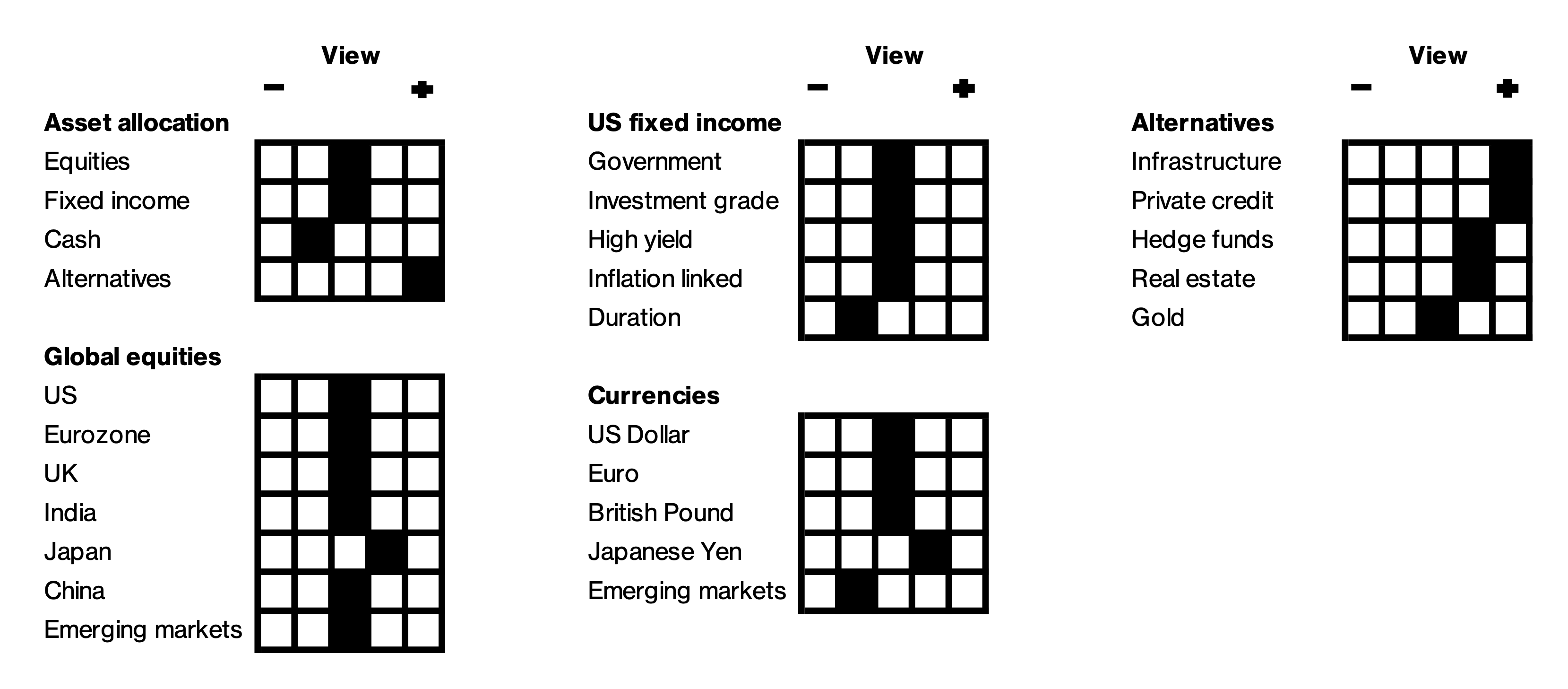
In this context, we introduce a new investment theme – “Reassess the risk-return relationship in your portfolio”.
The dynamics of the US dollar – strength becomes weakness
Perhaps the most intriguing development has been the recent behaviour of the US dollar. The traditional relationship between rising yields and currency strength has broken down – with the dollar weakening even as bond yields climbed. This divergence signals something more fundamental. With recent events, some have questioned the US dollar’s role as the world’s reserve currency which provides it with considerable insulation. International investors are already signaling their intention to reduce allocations to US assets. For bond markets, there could be a greater reliance on domestic demand to support US Treasuries. We will continue to monitor the evolution of this phenomenon.
Embracing Europe
We have favoured increasing exposure to European equities since the start of the year. The region stands at an inflection point where growth-orientated economic policies are beginning to bridge the gap that has in recent times separated Europe from the US. This has been driven by structural investments in critical infrastructure, defence capabilities and technological sovereignty – promising both immediate economic stimulus and the possibility of long-term competitive advantage. The European Central Bank’s disciplined approach – with rates unlikely to fall below 2% given projected growth of approximately 1.5% over the next 12 months – provides a stable economic backdrop that supports both currency strength and investment confidence. Some even view German bonds as having safe-haven appeal amid global uncertainties.
It is true that European equities benefit from attractive valuations and the prospect of flows out of US denominated assets, but more significantly the EU looks increasingly well placed in the context of global trade dynamics. With closer EU-UK cooperation on defence procurement and migration, likely trade agreements with the US and supply chain localisation across several sectors, the region is likely to emerge as a relative beneficiary of the reshuffling of global economic relationships taking place. In this context, we have a positive stance on the euro.
Justifying Japan
We continue to see both Japanese equities and the yen as compelling opportunities. For equities, valuations remain at a discount to US peers with the Nikkei 225 trading at around 14 times forward earnings versus over 20 for US stocks. This is further underpinned by record share buybacks of JPY17 trillion executed in 2024, equivalent to 30% of corporate profits, plus broader corporate governance reforms.
As for the yen, it benefits from a 15% undervaluation versus purchasing power parity and Japan’s first sustained inflation in decades which enables pricing power without crushing demand. The gradual rate hikes of the Bank of Japan will attract yield-seeking capital.
Assessing alternatives
On a risk-adjusted basis, we continue to believe that private credit offers a strong opportunity – providing investors with a blend of income, the potential for downside protection and diversification in a portfolio context. As an asset class, it has displayed resilience during periods of market stress such as 2008, 2020 and 2021, and more consistent performance than high-yield bonds and leveraged loans in these periods. Unlike high-yield bonds, private credit enjoys a senior positioning in the capital structure in contrast to the unsecured and subordinated nature of high-yield. BlackRock estimates that the private credit market will double to USD4.5 trillion by 2030 and sees an increasing opportunity set.
For many of the same reasons, we continue to like private infrastructure that offers exposure to digital infrastructure such as data centres, renewable energy and transportation networks – with BCG estimating that USD15 trillion of private capital is needed by 2030 to bridge the funding gap. It is our view that both private credit and private infrastructure are best accessed through top tier global managers with specialist expertise, deep resources and preferential access to deal flow.
On gold, we favour its defensive qualities and recommend a weighting in portfolios. That said, we do not see significant upside from this level unless there is an exceptional economic shock.
Finally, consistent with our new investment theme from last month – “Invest in hedge fund strategies designed for market volatility” – we advocate for hedge funds that adopt market-neutral and equity long-short in the current market environment. Our analysis shows that such funds can act as portfolio diversifiers and improve the risk-return profile of a portfolio overall.
Looking ahead – navigating the uncertainty
As we progress through June, we believe the investment landscape requires a more nuanced approach than simple bull or bear positioning. The pause in US trade tensions has provided valuable breathing room, but it’s temporary relief rather than permanent resolution. The US administration has demonstrated both willingness to use trade policy aggressively and sensitivity to market feedback – a combination that suggests continued volatility around policy announcements.
The key insight for investors is that we’re operating in an environment where policy uncertainty has become a permanent feature rather than a temporary disruption. Success will likely come from maintaining diversified exposures while remaining alert to both opportunities and risks as they emerge. We draw your attention to our new investment theme – “Reassess the risk-return relationship in your portfolio”. The music may have paused, but the orchestra is still tuning up for the next movement. All eyes are on the conductor.
Nick Perryman is Vice Chairman at InCred Global Wealth Limited and Chairman of its Investment Committee. He has over 25 years of investment and wealth management experience, holds advanced qualifications in investment management, financial planning and psychology, and was previously a managing director at UBS. He is co-author of “Leadership in Wealth: Mastering the opportunities of wealth in your family, firm and society.”